
The 8th Global Forum of the Milan Urban Food Policy Pact was held in South America for the first time. The event, whose theme was “Food to nourish climate justice: urban food solutions for a fairer world“, took place from October 17 to 19 at Cidade das Artes, a venue located in Barra da Tijuca, in the city of Rio de Janeiro.
What is it?
The Milan Urban Food Policy Pact, a non-binding agreement on urban food policies “conceived by cities for cities”, was signed in October 2015 in the Italian city that gives the document its name and represents one of the most important legacies of EXPO 2015, a world event whose theme was “Feeding the Planet, Energy for Life”. The Pact encourages the exchange of ideas and suggestions on how to concretely address common food-related problems. The initiative created a network of cities committed to developing and implementing sustainable food systems. Each year the Global Forum takes place in one of the Pact’s signatory cities, and Rio de Janeiro – which joined the Pact in 2016 – was chosen to host this year’s meeting. Rio de Janeiro had already hosted the Latin American regional meeting in 2019, with the curatorial coordination carried out by Comida do Amanhã. In addition to the meeting between cities, the Global Forum also hosted the 6th edition of the Milan Pact Awards. With more than 250 practices collected, awards went to projects submitted by cities in the categories of Governance, Sustainable Diets and Nutrition, Social and Economic Equity, Food Production, Food Supply and Distribution, and Food Waste. The number of submissions received this year exceeded expectations, and due to the high quality of the contributions, the Evaluation Committee decided, in addition to the main award, to grant 3 Special Mentions in each Award category. Being able to take part in the global meeting of the Milan Pact in the current Brazilian context is an enormous responsibility. As we know, food insecurity in Brazil has worsened, especially after 2020 with the Covid-19 pandemic, and today it affects more than half of the Brazilian population (58.7%), according to a survey carried out by the Rede Penssan, which has led municipal leaders to prioritize the fight against hunger. Brazil is a reference in food policies and in the design of successful governance models, involving cities as the main implementers of a number of these policies. At the same time, the way we produce, supply and consume our food has never been so sensitive to local and international debate – we have gone through periods of shortages, food prices are in an inflationary period, and our production model has threatened our ecosystems. We also face public health challenges, with obesity and malnutrition rates rising simultaneously.
LUPPA at the Milan Pact
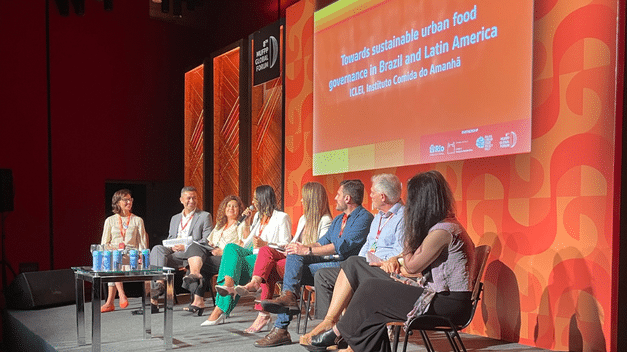
On the second day of the forum, LUPPA – Laboratório Urbano de Políticas Públicas Alimentares (Urban Laboratory of Public Food Policies) – was the subject of the panel Toward sustainable governance of urban food systems in Brazil and Latin America, organized by Instituto Comida do Amanhã and ICLEI South America, where we reflected on the role of local governments in building fairer, more sustainable and circular food systems based on the experience of the LUPPA cities Araraquara, Curitiba, Maricá, Osasco, Rio Branco and Salvador and on the contributions of FAO Food Agenda Coordinator Cecilia Marrochino. During the event we presented a collective position paper developed by LUPPA cities indicating the actions needed from state and federal governments and international bodies so that they can accelerate progress on their food agendas, a synthesis of work carried out in the LUPPA follow-up workshops, in which we set out to identify common issues for the development of municipal food policies, seeking to reflect on how to influence the 2022 international agenda (8th Global Forum of the Milan Urban Food Policy Pact and COP 27 in Egypt) and the agenda of the state and federal terms of office beginning in January 2023.
LUPPA cities join the Milan Pact and receive awards
This year, 3 more Brazilian cities joined the Milan Urban Food Policy Pact. Maricá, Osasco and Salvador signed the membership document, along with 46 other cities from different parts of the world. All three cities are part of the group of municipalities participating in LUPPA – Maricá, a newcomer as a participant in the 2nd edition, while Osasco and Salvador join the group of mentor cities. They join Araraquara, Belo Horizonte, Curitiba, Porto Alegre, Recife, São Paulo and Rio de Janeiro, Brazilian cities that were already part of the network. To date, more than 250 cities from every continent have signed the Pact. And two LUPPA cities saw their initiatives awarded and recognized as references in the food agenda: Araraquara received a special mention in the Governance category for the Araraquara Sem Fome (Araraquara Without Hunger) project, which sets up community urban gardens in the city’s outlying neighborhoods. The city of Curitiba, in turn, received a special mention in the Food Production category for the Fazenda Urbana (Urban Farm) project, which stands out for innovating and promoting sustainability in food production in Brazil.
Some reflections from our participation in the Forum
Throughout all the days of the event, it was clear that two points were present in most of the discussions: the importance of collaboration, and the absolutely intersectoral nature of successful policies that transform urban food systems. Collaboration between different actors (governmental and non-governmental) is a way to bring knowledge together and disseminate strategies to achieve common goals. Intersectorality in the governance structure, in turn, contributes to the implementation of more robust, sustainable policies that are attentive to territorial dynamics, respect the culture of local peoples, and address the local food agenda in a truly systemic way. Combining these integrated strategies with joint action across the different levels of governance (federal, state and municipal) is extremely important to change the current scenario and tackle the challenges related to food systems. Thus, when we talk about food security policies, we are talking about the importance of the work and engagement of city governments on this agenda, since they are responsible for implementing most of the programs, albeit in dialogue and coordination with state, federal and international structures. “Meetings like this one, which bring together cities from different regions of the planet, confirm an apparent paradox: while there are many similar initiatives pointing in the same directions, there are very different starting points and perspectives, especially when we compare cities in the Global South and the Global North. There is no detailed manual for local food policies precisely because they must vary and take into account the specificities of each territory. What they have in common is the recognition that the effectiveness of these policies and programs is directly proportional to the inclusion and engagement of the diversity of actors in the local food system. That is why the major impact theme of this Milan Pact Forum was the governance of local food policies and the corresponding capacity for the democratic construction and monitoring of these decision-making processes,” emphasizes Juliana Tângari, LUPPA’s general coordinator. A systemic view of food allows actions to be carried out in an orchestrated way, so that each actor can see their role and work in a committed manner to make the transformation happen, in order to confront what has historically marked our country: hunger, poverty and social inequalities.
Local experiences
In addition to the moments of exchange between cities that took place in the plenary and panels, Forum participants had the opportunity to get a close look at some of the initiatives carried out in the region’s municipalities. On the last day of the event, some of the representatives present at the Forum had the opportunity to learn about successful local experiences. Some participants visited the Dirce Teixeira garden, in Jardim Anil, one of the 56 gardens of the Hortas Cariocas program, coordinated by the Municipal Department of Environment and Climate of Rio de Janeiro. In 2019, the program received an honorable mention at the Milan Pact in the Food Production category (2019). Other participants had the opportunity to visit the city of Maricá and see the Araçatiba Agroecological Square, a place where the vegetables and greens grown there are available to the population. Next, the delegation that visited the city went to the Dehydrated Foods Factory and the Joaquín Piñero Public Farm, an experimental and educational space dedicated to production and teaching for the local community. These were excellent opportunities to exchange knowledge and experiences on site, strengthening cooperation between cities.
An opportunity for the Food and Cities agenda
Being able to take part in this event gave us the opportunity to deepen our exchanges with cities of different sizes and realities and to further strengthen our work focused on supporting the transformation of urban food systems, seeking to ensure resilient cities with healthy, fair food that is accessible to all. Seeing LUPPA cities bringing examples to the world, following their engagement, and witnessing their recognition through exchanges and awards is a source of joy and pride for us. The agenda is urgent, and cities are increasingly positioning themselves as protagonists.