
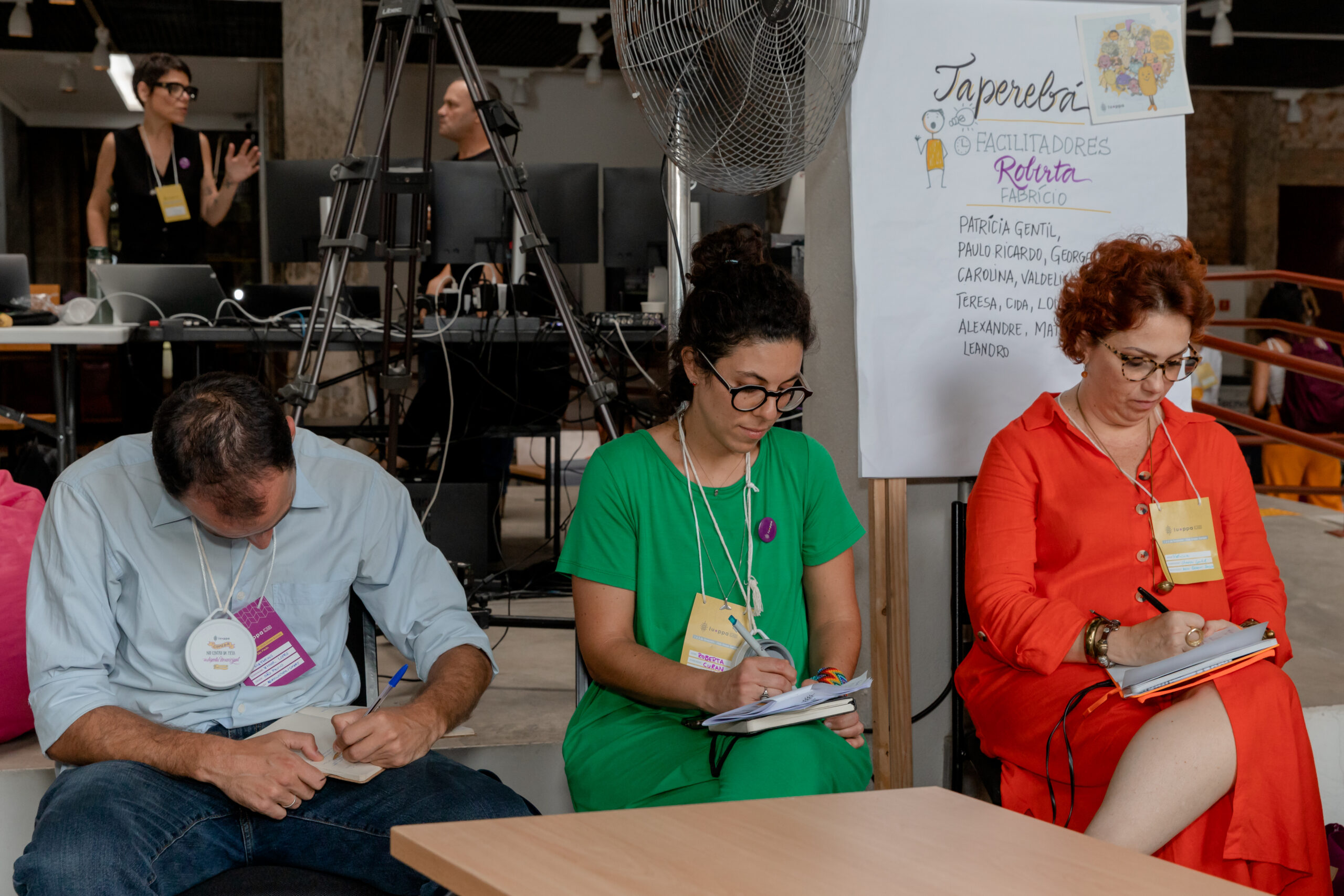
In this second edition of the Laboratório Urbano de Políticas Públicas Alimentares (LUPPA – Urban Laboratory of Public Food Policies), the LUPPA LAB (an immersive meeting between cities) will take place from February 1 to 3, in the city of São Paulo.
Unlike the first edition of LUPPA, in which the LAB was held entirely online, this will be an in-person meeting, where representatives of LUPPA cities (from the first and second editions) will have the opportunity to dive deeply into urban food agendas, exchange information with one another, and strengthen themselves methodologically and thematically.
The LAB is a key moment in the journey of each LUPPA edition, and it is an event exclusively for representatives of the participating cities. In this text we will explain a little more about what the LAB consists of and some of its main guidelines. That way, even if you are not taking part in the meeting, you will be able to better understand what happens there.
And it is always worth remembering that here on the website we have a range of content available to the public – LUPPA notebooks, reference documents for the LAB, a glossary of food systems terms, etc. We also have recordings of several LUPPA livestreams we have held with experts, all available on our YouTube channel. So we invite you to learn more, become more interested and, who knows, bring your city to LUPPA as well. 🙂
What happens at LUPPA LAB?
LUPPA LAB is the moment when all participating cities dive into an intense journey of learning and exchanging experiences with one another.
It is at the LAB that:
Municipal officials share their challenges and success stories, and hear from others about the solutions other cities have found to challenges that are often shared.
Representatives of social oversight councils also add their voices to this process of identifying challenges and setting priorities.
In this process, everyone’s knowledge of specific urban food systems agendas (such as urban agriculture, school meals, circular systems, etc.) expands considerably.
We dive into a methodological journey on systems thinking, extended collaboration, intersectorality, and the development of action plans that chart routes for building Food and Nutrition Security (FNS) strategies.
Although the LAB meeting is the most intense moment of the entire LUPPA laboratory, it is not the only one. Each LUPPA edition has a one-year cycle of activities, which include several workshops and content production, such as seminars dedicated to city participants, exchange of experiences and content through the website (participating cities have an exclusive area dedicated to them), development of each city’s diagnosis of its urban food system, development and publication of the LUPPA map, publication of content about the LAB (LUPPA notebooks), livestreams open to the public (LUPPA web), and mentoring journeys between participating cities and mentor cities, where a great deal of exchange and learning takes place.
LUPPA is thus an intense, year-long journey that delivers an extended repertoire of possibilities so that cities become increasingly capable of developing their food strategies in an integrated, participatory way, with systems thinking and aligned with global challenges and local needs and possibilities.
Intersectorality, political will, social participation and mutual learning – the guiding principles of the LAB
LUPPA is a laboratory designed to place cities at the center of the food agenda debate, making them protagonists and supporting them in developing their food strategies in an integrated, intersectoral way, with social participation. For this to happen, political will is essential, and for this process to be strengthened and effective, cities can learn a great deal from one another.
At the LAB meeting, as throughout the LUPPA process, these principles are fundamental. Here is why.
Intersectorality
Urban food systems are complex by nature. Food and cities meet in many areas, from food production (for example, urban agriculture), food supply (for example, municipal markets), means of distribution (for example, street markets), policies for access by vulnerable populations (for example, solidarity kitchens and popular restaurants), school meal policies, measures to encourage production through public food procurement, actions to combat food waste, food and nutrition education actions, measures to regulate food environments (for example, banning the sale of certain products in public facilities), and the list goes on…
It is in cities that the food system meets the majority of consumers, and it is also in cities that innovative policies can be designed and implemented, capable of responding to the specific demands of their inhabitants. Cities are places of innovation par excellence, where public officials are very close to their residents.
Knowing this, we designed LUPPA to ensure that some of this complexity of food systems would be considered throughout the cities’ entire journey. A food and nutrition security plan, or an action to improve the population’s access to food, has greater potential to be effective, inclusive and sustainable if several municipal departments work together on its design, implementation and monitoring. Intersectoral work is very important for advancing urban food agendas. For this very reason, each city participating in LUPPA appointed at least 2 people to represent its administration, necessarily from different departments. This is one of the conditions for any city to take part in LUPPA, as defined in the selection call for applications we publish before each edition.
At LUPPA LAB we encourage cities to send 2 representatives of their administration to the meeting, and in the various virtual meetings we hold with the cities throughout LUPPA, we encourage as many participants as possible from the various departments. In addition to strengthening the policies and actions of their food agenda, intersectorality allows colleagues to meet, help each other and strengthen one another in their work serving the population.
Political will
The successful implementation of a public policy depends on the merit of the technical teams in municipal bodies and on the political will of those in charge. Mayors who understand the importance of the urban food agenda are allies in all progress made at the local level. This commitment is what ensures that structured, innovative projects, actions and plans that are attentive to local demands are effectively implemented and considered in the municipal budget and in the municipality’s priorities.
For this very reason, all LUPPA cities are asked to submit, at the time of application, a letter of commitment signed by their mayor. This commitment is essential so that the technical teams can dedicate themselves to LUPPA’s work and bring the results of their participation back to their city, impacting the local agenda and the capacity to develop food actions and policies.
Social Participation
For the sound management, implementation, review and monitoring of public policies, it is essential to listen to the population.
The structure of the municipal executive branch provides for the formation of social oversight councils for various areas of municipal management. In these councils, members of civil society take part in management processes, either in a purely advisory capacity or with some deliberative power.
This organized civil society is essential for food policies to be effective, to have positive results for the population, and to be continuously improved through monitoring by those who benefit from them – the stakeholders.
That is why, in LUPPA, each participating city must appoint a civil society representative who belongs to the social oversight body most closely related to the local food agenda – this may be a food security council or, if that is not active, a school feeding council or a rural development council, for example.
At LUPPA LAB, several civil society representatives from the participating cities will be present, taking part in all activities together with the representatives of the municipal administration. A strong and sustainable urban food system depends on dialogue and joint work between the municipal administration and civil society; and in LUPPA this is a structuring element of the entire process.
Mutual learning
One city’s solution may be useful for another’s challenge. At LUPPA we have great confidence in the capacity for mutual learning among actors. We encourage municipalities to share their challenges with the others, as well as the solutions they have developed. This capacity for exchange has proven to be the most powerful engine for advancing public policies and urban food actions. A municipality that has found ways to unlock processes locally can bring its experience to another municipality that is now facing a similar challenge.
At LUPPA, cities find a safe space to share their difficulties and help one another, but also to share their good practices and successes, and to celebrate together.
This space of trust and continuous learning not only helps the representatives’ technical work and the progress of their local actions, but is also very important so that participants can recognize the value of their work, their capabilities and achievements, so that they feel valued and empowered.
Over the three days of the LAB, there will be many moments of exchange between cities, sometimes in small groups and sometimes in plenary with the larger group. The cities will also have the opportunity to visit initiatives carried out by the City of São Paulo, a LUPPA mentor city and host of LAB #2, which will offer technical visits to some of its most significant projects on the local food agenda.
Who takes part in LUPPA LAB?
LUPPA LAB is the most intense moment of the entire Laboratory, and it is a closed event for participating cities and mentor cities.
The LAB’s overarching objective is to expand the ways in which city governments equip themselves to develop their food and nutrition security plans in an integrated, multisectoral way, with social participation. The entire LAB is designed to make the best possible use of the municipalities’ work.
At LUPPA LAB #2, the representatives appointed by LUPPA cities will be together in person for 3 days, during which they will be able to dive into various topics on the urban food agenda, share the actions, policies and projects they are already developing, and learn about what other LUPPA cities are doing as well.
The LAB is designed so that participants can strengthen their capacities and develop their policies in a participatory, multisectoral and integrated way, with systems thinking. To make this possible, the following take part in the LUPPA LAB #2 immersion:
- representatives of the municipal administration from a department or body linked to the municipal food agenda (as appointed by the participating city);
- civil society representatives who are part of a social oversight body (municipal council) most directly related to the urban food agenda (for example, CONSEA, CAE, CMDR, etc.), as indicated by the city at the time of selection ;
- representatives of LUPPA mentor cities – cities that have already developed their food strategies, have strengthened governance structures and good practices to share;
- LUPPA partners and mentors – representatives of our partner organizations that contribute to the laboratory by bringing content and specialized knowledge on topics of interest to the food agenda of participating cities.
How to become part of LUPPA?
LUPPA is essentially made up of cities and partner organizations.
The cities
Among the cities there are (i) participating cities, which take part in all moments of the LAB and in LUPPA’s other activities, learning from the others and strengthening themselves so they can develop their own food strategies; and (ii) mentor cities, which take part in some moments of the LAB and lead mentoring journeys with the participating cities under cooperation agreements – these are cities that have already made progress in their local food policies and have solid governance structures in place.
Participating cities are selected through a call for applications, published before the start of each edition of the laboratory (one per year) on the website luppa.comidadoamanha.org, aimed at cities with up to 1.5 million inhabitants that meet certain requirements. The opening of the call for applications is announced on the social media of the organizing institutions, on the LUPPA website and through the Instituto Comida do Amanhã newsletter.
The same process applies to the selection of mentor cities.
Both mentor cities and participating cities can renew their engagement with the program each year.
The partner organizations
Among the partner organizations there are (i) mentor organizations, which contribute technical knowledge to LUPPA based on their areas of expertise, and (ii) supporting organizations, which contribute financial and material resources to LUPPA, enabling the implementation and continuity of the Laboratório Urbano de Políticas Públicas Alimentares.
For more details on how to become a partner organization, contact us by email at luppa@comidadoamanha.org.
LUPPA is a project of Instituto Comida do Amanhã, co-implemented with ICLEI South America, with full support from Instituto Ibirapitanga and ICS – Instituto Clima e Sociedade, special support from the Delegation of the European Union to Brazil, Embrapa and WWF Brazil, institutional support from ACT Promoção da Saúde, Alimentação Consciente Brasil, the Food and Agriculture Organization of the United Nations – FAO Brazil and Humane Society International, and methodological partnership from Reos Partners.
Our second edition features mentoring from the cities of Curitiba, Osasco, Recife, Salvador and São Paulo and from the organizations: Josué de Castro Chair on Healthy and Sustainable Food Systems at USP – Universidade de São Paulo, CECANE – Collaborating Center for School Food and Nutrition at UFAM – Universidade Federal do Amazonas, GEPPAAS – Group of Studies, Research and Practices in Food Environment and Health of the Universidade Federal de Minas Gerais – UFMG, GEPAD – Research Group on Agriculture, Food and Development of the Universidade Federal do Rio Grande do Sul – UFRGS, IDEC – Instituto Brasileiro de Defesa do Consumidor (Brazilian Institute for Consumer Protection), Instituto Kairós Ética e Atuação Responsável and Instituto Regenera.