
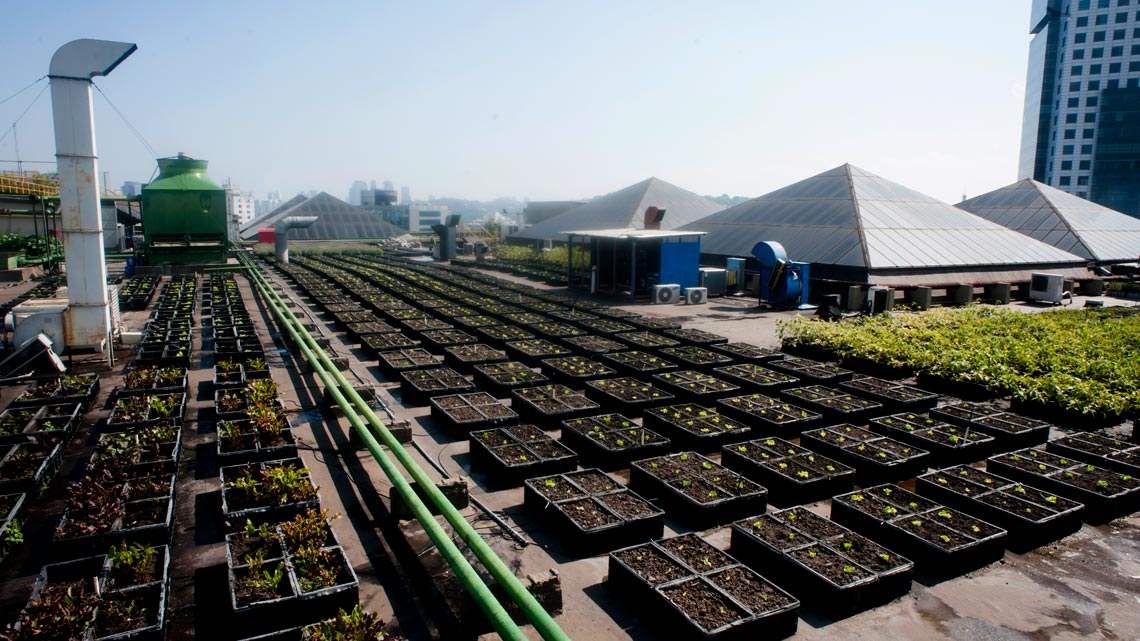
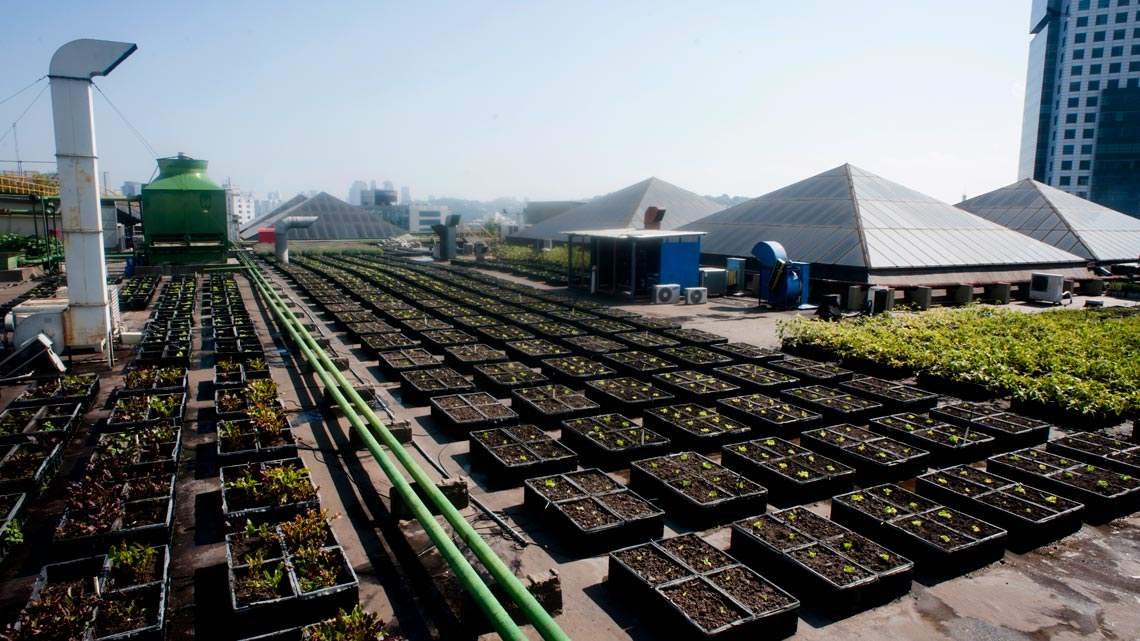
Vegetable garden grown on the roof of Shopping Eldorado, one of the largest malls in the city of São Paulo. Photo by Léo Ramos Chaves
The first weeks of the Covid-19 pandemic in 2020, when social isolation measures were implemented and followed by a reasonable share of the Brazilian population, exposed a weakness in the food supply system. Scenes that had been seen in another crisis two years earlier, during the truck drivers’ strike, were repeated: while supermarkets were partly out of stock, fresh food fit for consumption was being thrown away, since the chains that move products to market had been broken. The impact on this production system was felt to a large extent because a good share of what is consumed in cities is produced outside them, and because transport chains and sales channels broke down. “With the pandemic, people realized that it is important to strengthen local production. The small or medium-sized farmers who did best were those who made a direct connection with consumers, for example by delivering produce boxes, without intermediaries,” says physician Thais Mauad, coordinator of the Urban Agriculture Study Group at the Institute of Advanced Studies (Geau-IEA) of the University of São Paulo (USP) and professor at the institution’s School of Medicine (FM).
Although the pandemic brought into focus the agriculture practiced within and around municipalities and metropolises, the movement to make urban areas greener and more sustainable has been gaining strength, in Brazil and around the world, since the early 2000s. This trend follows the evolution of studies and evidence on the climate emergency the planet faces because of global warming, as well as the dizzying growth of cities in the most varied regions of the world. According to the 2015 National Household Sample Survey (Pnad) by the Brazilian Institute of Geography and Statistics (IBGE), 85% of the Brazilian population lives in urban areas and only 15% in rural areas. In the Southeast, the share living in cities reaches 93%.
The Food and Agriculture Organization of the United Nations (FAO) estimates that 80% of global food production is destined for consumption in urban areas. In 2018, these regions produced 15% of the world’s food, according to the United States Department of Agriculture (USDA). The concept of urban and peri-urban agriculture (known by the acronym AUP in Portuguese, or UPA) is the subject of debate among academics and policymakers, but in general it covers crop and livestock production carried out within the urban perimeter of municipalities and on the fringes of cities.
The activity includes production for commercial purposes and for family and community self-consumption, as well as for other purposes, such as education, activism and leisure. Thus, everything from plants grown on a terrace or in a backyard for one’s own consumption to green roofs, high-tech vertical farms, community gardens or more conventional plantations within or around the urban perimeter falls under this definition. It is practiced by individuals or by formal or informal organizations, in public or private spaces, under the most diverse social conditions, in every region of Brazil, often with little or no support from public policies.
As a result, obtaining data on this type of agriculture in the country is a challenge, and there is no consolidated information on production across the national territory. The IBGE Agricultural Census, the main statistical survey on the structure and output of Brazilian agriculture and livestock, does not single out urban agriculture when publishing its data. “This is an issue that has already been widely debated by those who research urban agriculture and by IBGE itself, since census tracts [the smallest territorial unit for which the institute publishes information] follow the political-administrative division. Defining urban and rural territory is the responsibility of the municipality and has tax implications, which makes it very difficult to establish objective criteria for what is urban and what is rural nationally in the context of public policy,” says family farming researcher Vitória Leão, project analyst at Instituto Escolhas, a non-profit civil association based in São Paulo, and member of Geau-IEA. Thus, researchers studying the topic have to pore over the microdata for each of the country’s 5,568 municipalities.
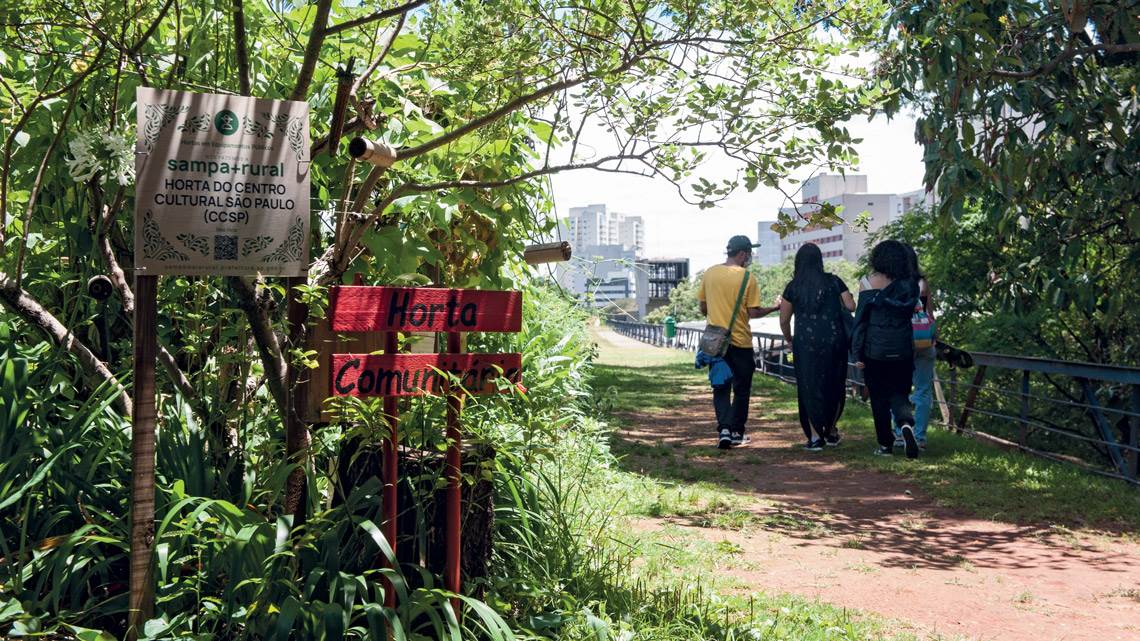
Community planting of greens and vegetables at Centro Cultural São Paulo, near the city center. Photo by Léo Ramos Chaves
Poverty reduction
According to FAO, by encouraging people to grow their own food or obtain it from community gardens, agriculture practiced in cities can reduce the poverty and food insecurity aggravated by urbanization, while also improving the health of urban residents and preserving the environment. For this reason, FAO considers encouraging this type of production a priority, stressing the importance of including the topic in urban planning. The pandemic period was also marked by a worsening of food insecurity around the world, including in Brazil, where an estimated 19 million people faced hunger in 2020, according to a report by the Brazilian Research Network on Food Sovereignty and Security (Rede Penssan).
A simulation by Instituto Escolhas indicates that agriculture practiced in the São Paulo metropolitan area, including urban areas, has the potential to supply 20 million people a year with vegetables and greens and to generate 180,000 jobs, using only land currently used as pasture and without occupying forest areas or environmental protection areas. IBGE’s 2017 Agricultural Census showed that the 5,000 agricultural establishments in the São Paulo Metropolitan Region employed 20,000 people when the survey was carried out.
Taking into account only the total amount of vacant land in the Sapopemba district, in the city’s east zone – an area of 200 hectares, the equivalent of 200 city blocks – production would be enough to supply 80,000 people with vegetables and greens. The number of families served would be 1.5 times greater than the number registered in the Bolsa Família program in that district, according to Instituto Escolhas.
In an article published in early 2021 in the journal Estudos Avançados, a group of researchers coordinated by Mauad examined data on the municipality of São Paulo in detail and showed that, even with evident underreporting, an increase in the city’s agriculture over the last 15 years can be observed. Comparing data from the 2006 Agricultural Census with the 2017 census, the most recent, the number of agricultural establishments increased from 193 to 550. In addition, the agricultural area used for commercial purposes rose from 8,000 hectares to almost 11,000 hectares over the same period. IBGE defines an agricultural establishment as any production or operating unit dedicated, wholly or partly, to farming, livestock, forestry and aquaculture activities, regardless of its size, legal form or whether it is in a rural or urban area, and whether for commercial or subsistence purposes.
According to the Census Survey of Agricultural Production Units (UPA) of the State of São Paulo, there was growth of approximately 22% in the number of UPAs and 33% in production area between 2007/2008 and 2016/2017 in the city of São Paulo. Lettuce was grown in 102 production units in the latest survey, making it the most widespread crop by number of establishments in 2017. Other prominent crops were collard greens (in 93 UPAs) and broccoli (65). In terms of area occupied, there were 247 hectares (ha) of brachiaria, a grass used as cattle feed. Pasture was followed by cut-flower growing (231 ha) and lettuce production (222 ha).
At the beginning of November, the City of São Paulo’s Sampa+Rural platform listed 735 agricultural production units, most of them (574) in the south region, 60% in areas ranging from 0.1 to 5 ha, and 28% headed by women. But urban agriculture is spreading throughout the country, with examples of strong and successful activities in cities such as Belo Horizonte, in Minas Gerais; Rio de Janeiro, as in the Hortas Cariocas program; Maringá and Curitiba, in Paraná; and Teresina, in Piauí, among others.
The researchers stress that urban agriculture is not only about commercial production. “When we talk about urban agriculture, we are talking about a vast universe. It is truly a plural practice,” notes geographer Gustavo Nagib, who completed his PhD in 2020 analyzing the space of urban agriculture as activism, focusing on the cases of Paris and São Paulo.
“Urban agriculture allows us to rethink socio-environmental conditions from the standpoint of urban ecology, rural-urban integration and the reintroduction of biodiversity into cities, whether animals, such as pollinating insects, or plants we can eat,” says Nagib. “On the other hand, it also enables us to act against hunger and precariousness, giving people the opportunity to save resources and gain autonomy by producing their own food.”
Author of the book Agricultura urbana como ativismo na cidade de São Paulo, Nagib explains that, from an activist perspective, the discourse and practice of urban agriculture focus on reoccupying the city’s public spaces and restoring contact with nature. He also highlights that the movement proposes strengthening social bonds that may have been lost in large urban centers and seeks to draw attention to what collective work is and what a public space for collective use is. It is no coincidence that agriculture practiced in cities and their surroundings also often follows the principles of agroecology, based on respect for all forms of life, which seek to move away from purely anthropocentric (human-centered) approaches.
Drawing on more traditional techniques, such as those practiced by Indigenous peoples, cooperatives, associations and communities have grown and are reaping the fruits of urban agriculture. “This practice gains strength especially in times of economic crisis, because people lose purchasing power and cannot afford to buy food,” says geographer Angélica Nakamura, whose master’s research examined the work of the Cooperativa dos Produtores Rurais e de Água Limpa de São Paulo (Cooperapas), formed by agroecological farmers in the far south of the municipality of São Paulo, a watershed region.
Often moving in the opposite direction to the activist discourse – but taking advantage of the growing demand for local, pesticide-free food production – major cities around the world are seeing the emergence of a new generation of vertical farms, where plants can be grown without a single grain of soil.
Using hydroponic systems (in which vegetables are grown in an aqueous solution), aeroponics (a system in which plants do not come into contact with water, only with its vapor) or aquaponics (hydroponics combined with fish farming), these companies rely on technological advances provided by the Internet of Things, machine learning and embedded computing to partially or fully control the growing environment. Indoors, climate variations, an essential issue in the field, do not interfere with production.
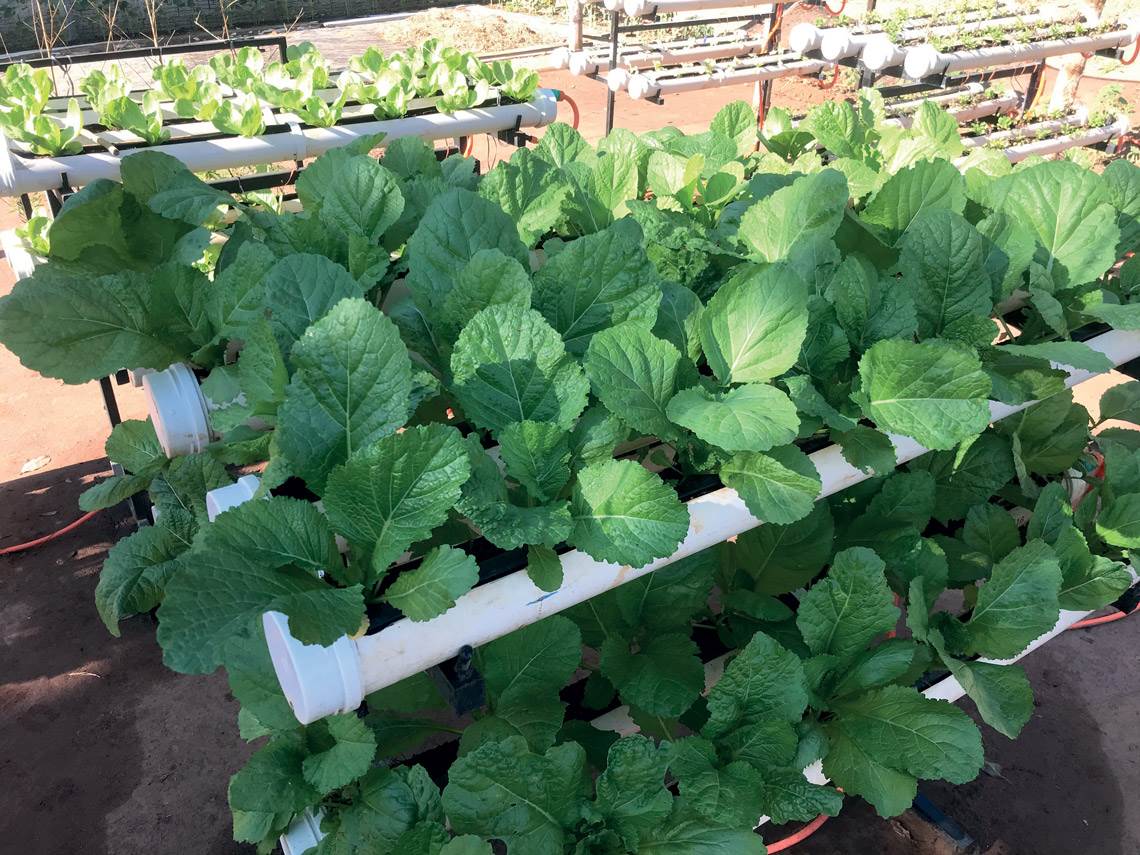
The Babilônia platform for growing food in open spaces, created by a startup. Photo by Milton Godoy Saito
In São Paulo, one of the largest is Pink Farms, which runs a high-tech pilot farm with a 150-square-meter (m2) growing room in the city’s west zone. It currently produces 1.5 tons (t) of hydroponic lettuce per month in a tower that occupies less than 70 m2 and has 10 levels (or floors). The expectation is to reach 3 t per month once a second tower is completed in November. The company also produces between 100 and 200 kilos of sprouts, known as microgreens (such as leek, carrot, cilantro, kale and mustard, among others), every month. The plants float in trays containing a nutrient solution. According to the company, it uses 60% less fertilizer than conventional agriculture. There are also water savings, as water can be reused for up to 60 days before being discarded.
“In terms of efficiency, of productivity per area, we are far superior to the field. We are able to optimize space by increasing plant density and growing vertically,” says production engineer Henrique Pauli, who is in charge of Pink Farms’ operations. Much of the process is automated, including control of temperature, humidity, light and the emission of gases such as carbon dioxide, to accelerate photosynthesis. The cost of operation, however, is higher than that of conventional planting – the company does not disclose the figures.
Lighting is provided by LED lights in a mix of blue and red, giving the space a pink hue – hence the company’s name. According to Pink Farms agronomist Luana Borges, the LEDs simulate sunlight and speed up the plants’ photosynthesis. The idea is to keep the environment as sterile as possible, avoiding contamination by bacteria, viruses and protozoa. “At our current farm, harvesting and transplanting are still done manually by employees, but at the new farm, scheduled to start operating next year, all of this and the packaging process will be automated. The intention is to bring in robots to gain scale,” Pauli explains. The company is raising funds to expand the business and build new facilities, which are expected to have solar and/or wind panels to reduce electricity costs, as well as technology to reuse 100% of the water.
A benchmark for Pink Farms is the American company AeroFarms, founded in 2004 and headquartered in New Jersey, which today sells 550 varieties of fruit and vegetables produced in controlled environments – in renovated spaces that were once factories, paintball fields and even an abandoned nightclub. AeroFarms is involved in building what promises to be the world’s largest vertical farm in Abu Dhabi, in the United Arab Emirates, a country that suffers from severe water scarcity. The largest vertical farming company in the US is Bowery, headquartered in Manhattan, New York, whose investors include musician Justin Timberlake and actress Natalie Portman, according to The New York Times.
In the state of São Paulo, computer engineer Milton Yukio Godoy Saito is developing, with support from FAPESP’s Innovative Research in Small Businesses (Pipe) program, a sustainable urban vertical farm platform for open spaces, initially designed to be installed on the roofs of shopping malls and business complexes. Called Babilônia, the model uses natural light (avoiding electricity costs), does away with pesticides and chemical fertilizers, and has sensors that detect the moisture of the growing substrate, which is produced from organic waste. Although it uses PVC pipes like those in modular hydroponic systems, the platform uses soil and creates a semi-controlled environment, unlike the fully controlled environments of Pink Farms, for example. With a smart irrigation system, sensors monitor the production units minute by minute.
“The major challenge we have encountered so far is that end consumers still do not see value in a vegetable with a low carbon footprint. People don’t take into account that there is a whole chain between production and retail, which involves waste and fossil fuel consumption. When the financial side comes into play, they opt for the cheapest or for the biggest, greenest leaves,” says Saito.
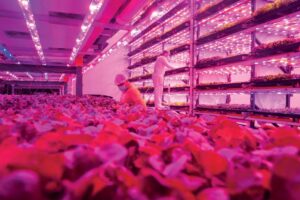
São Paulo company Pink Farms uses colored LED lights that emulate solar radiation at its pilot farm. Photo by Léo Ramos Chaves
Still studying the ideal business model for the platform, the engineer says he is seeking investment outside Brazil, especially in the Middle East and Europe, to boost the business. “That’s where we see the most opportunities. We are still taking our first steps in this area here.” He also says he has often been asked about the need for vertical urban farms in a country like Brazil, with its vast expanses of land. “We forget that land here is becoming increasingly unsuitable for agriculture and water is becoming scarce. These are issues that will become more visible in the medium and long term.”
Also with an eye on the European market, the São Paulo company Instituto Cidade Jardim developed, with support from the Pipe-FAPESP program, a cultivable hydroponic roof tile system that does not require prior waterproofing of the slab. The sandwich tile designed for cultivation was named Kaatop, and its ninth version is being improved with the aim of lowering costs. Patents have been granted in Brazil, the United States and Europe.
“The green roof is great because it is a multifunctional technology. It is a tool that doesn’t only address the sustainability axis related to water, energy or well-being, but helps solve several problems at the same time: it improves air quality, sequesters carbon, produces food, reduces electricity consumption and reduces runoff in cities,” says agronomist Sérgio Rocha, founding partner of the startup, which also carries out projects with the traditional green roof system, using modular plastic trays placed on waterproofed slabs.
“The green roof market worldwide today is perhaps one of the most promising and active markets for regenerative technologies [which seek to mitigate human-caused environmental damage]. In Europe alone it moves almost 500 million euros a year, and that’s just for flat roofs,” he comments. He notes, however, that it is an expensive technology, currently accessible only to companies or owners of high-end homes.
Instituto Cidade Jardim also has an activist and awareness-raising side to promote good practices, with a focus on roofs. “We want people to see roofs as spaces for transformation. Few people realize it, but they are responsible for a large share of cities’ problems, since most of the urban surface is covered by roofs and slabs. Having green space over our heads can help solve a whole range of urban pathologies,” says Rocha. According to him, depending on the type of green roof, it is possible to retain more than 70% of rainfall volume. “Together with other urban planning tools, green roofs have enormous potential to help combat flooding – in addition to producing food for city dwellers.”
Projects
- Telha Sanduíche Cultivável: um novo sistema para telhados verdes que não demanda impermeabilização e coloca o mercado de telhas na mira da sustentabilidade (nº 16/10264-3) Grant Program Innovative Research in Small Businesses (Pipe) per já voFinep Pipe-Pappe Subvenção; Principal Investigator Sérgio Fausto Rizzi Rocha (Instituto Cidade Jardim); Investment R$ 121,565.06.
- Criando uma plataforma para a agricultura sustentável em espaços urbanos (nº 19/01050-8) Grant Program Innovative Research in Small Businesses (Pipe); Principal Investigator Milton Yukio Godoy Saito; Investment R$ 89,772.89.
Scientific articles
AMATO-LOURENÇO, L. F. et al. Building knowledge in urban agriculture: the challenges of local food production in Sao Paulo and Melbourne. Environment, development and sustainability. v. 23, n. 2, p. 2785-96, 2021.
NAGIB, G. et al. Urban agriculture in the city of São Paulo: New spatial transformations and ongoing challenges to guarantee the production and consumption of healthy food. Global Food Security – Agriculture, Policy, Economics and Environment. v. 26, p. 1-7, 2020.
BIAZOTI, A.R. et al. The Impact of COVID-19 on Urban Agriculture in São Paulo, Brazil. Sustainability. V.13, p.6185, 2021.
This text was originally published by Pesquisa FAPESP under the Creative Commons CC-BY-NC-ND license. Read the original here.