
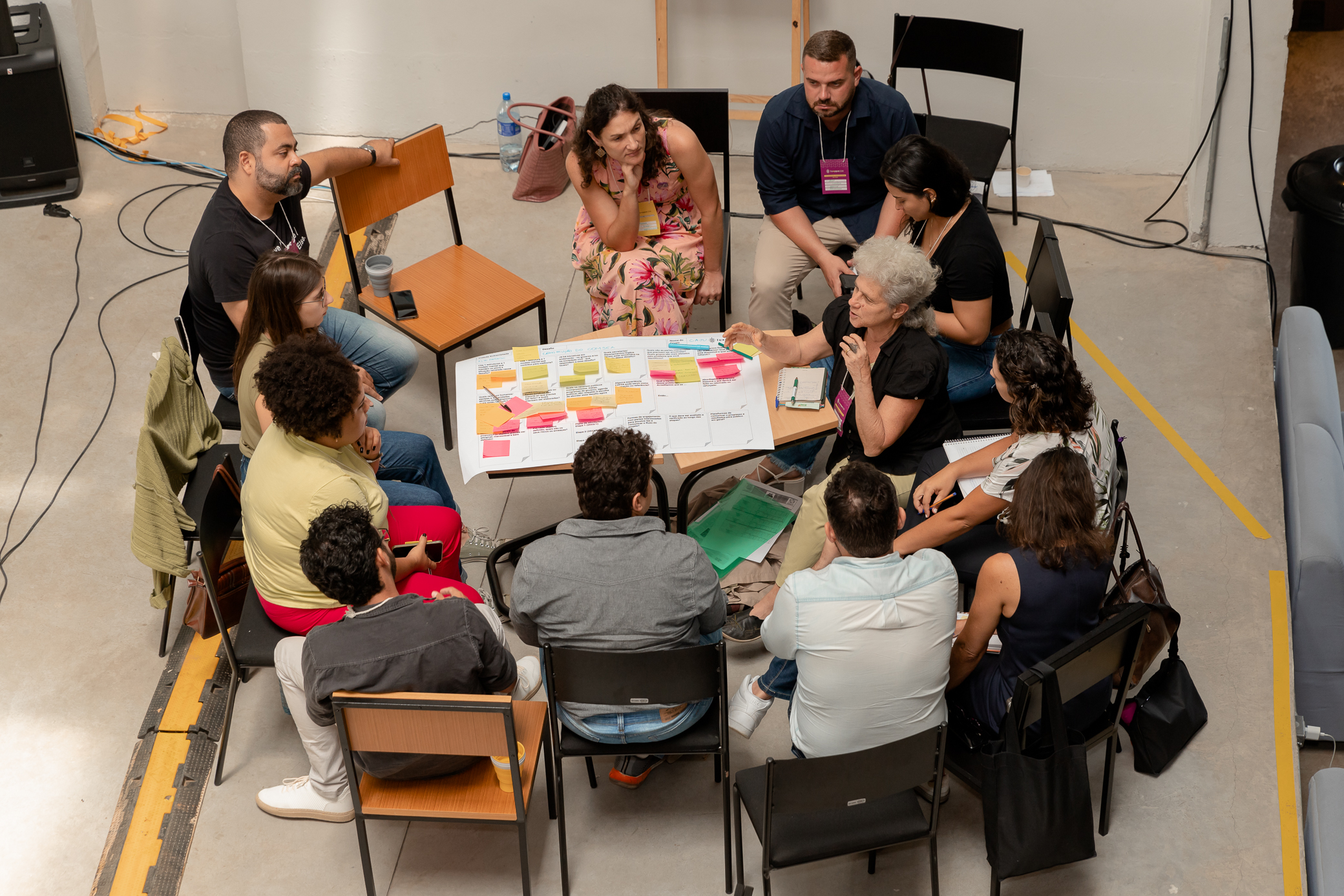
LUPPA is only in its 2nd year of operation, and we are aware that we still have a lot of work ahead of us. In addition to the organizing, planning, coordination, design and technical cooperation work that Instituto Comida do Amanhã and ICLEI carry out in full synergy, we believe in the power of collective work, and our partners are a key part of this process. A very important partnership, essential to the project, is with the mentor cities. In this article, we will tell you a little more about the mentoring methodology used by LUPPA and the importance of these actors in the process.
THE VOICE OF EXPERIENCE
Mentor cities are cities that have already advanced in their food systems policies and have matured and evolved their food and nutrition security planning; therefore, they can contribute their accumulated expertise and experience to the other participating cities. They are responsible for organizing and providing mentoring that takes place in the second phase of each LUPPA cycle, in which a group of cities is selected to work with each mentor. At LUPPA LAB#2, held from February 1 to 3, the mentor cities shared a little of their realities as a taste of what will be worked on within the groups. Tainara Ferreira, Director of Resilience of Salvador, Bahia, highlighted the importance of working together with the population, understanding nuances, culture and traditional knowledge, and having that sensitive perspective. She also stressed that Salvador is a city with a majority Black population and that Black women make up the majority of heads of households suffering from food insecurity, so it is necessary to take this social dimension into account. João Paulo Pucciariello Perez, Director of the Food and Nutrition Security Department of Osasco, São Paulo, pointed out that public policy begins with a problem, and this demands joint work between government and civil society. As an example, he mentioned the Educational Gardens project, which stemmed from the proposal to set up agroecological gardens in schools as a tool to support the teaching and learning process. The initiative was carried out in partnership with companies and institutions in the city. Morgiana Maria Kormann, technical coordinator and nutritionist at the Department of Food and Nutrition Security Strategies of Curitiba, Paraná, talked about the process of building the Food and Nutrition Security plan, stressing that, even though the city has a Municipal Department of Food and Nutrition Security that centralizes information on the subject, seeking intersectoral work with other departments and listening to the population’s demands is essential. Alexandre Ramos, manager at the Executive Secretariat of Urban Agriculture of Recife, Pernambuco, talked about the experience of collectively building the agroecology plan in a completely urban city. The building of the plan began at a seminar and involved various sectors of society, which made more than 270 contributions. Lia Palm, Coordinator of Agriculture and Food and Nutrition Security of São Paulo, spoke about the Sampa Mais Rural program and its role in reviving and recognizing agriculture for the city. For her, the expectation for the mentoring is to share and jointly learn some social technologies for public policy. Darklane Dias, Undersecretary of Food and Nutrition Security of Belo Horizonte, Minas Gerais, a city that served as a mentor in LUPPA’s 1st edition, sent a video message to those present at the LAB and told a little about how the mentoring process with the municipalities went, explaining that laying bare the challenges to be overcome in order to achieve results was her main goal as a mentor city. How LUPPA, an innovative lab, works to transform the urban food agenda in Brazil
METHODOLOGY
Building a learning space among municipal government officials and other actors in urban food systems is important and necessary; for this reason, the mentoring takes the form of close technical cooperation in which this knowledge can be much better absorbed and a deeper exchange can take place between mentor cities and mentored cities. Sharing both success stories and the challenges faced makes it possible to establish a learning environment that goes beyond theory, with those who learned in practice. In this second edition, the mentoring is divided into the following groups:
- Curitiba: Abaetetuba, Barcarena and Belém, all in Pará
- Osasco: Araraquara – SP, Bragança – PA and Palmas – TO
- Recife: Alvarães – AM, Pindamonhangaba – SP and Vitória do Mearim – MA
- Salvador: Maricá – RJ and Nova Lima – MG
- São Paulo: Alto Paraíso de Goiás, Jundiaí – SP, Santarém- PA
__ LUPPA is a project of Instituto Comida do Amanhã @comidadoamanha, co-organized with @iclei_sams, with full support from @iibirapitanga and ICS – Instituto Clima e Sociedade, special support from @UEnoBrasil, @embrapa and @wwfbrasil, and institutional support from FAO Brazil – Food and Agriculture Organization of the United Nations, @insta.act, @alimentacaoconscientebr, and @hsiglobal.