
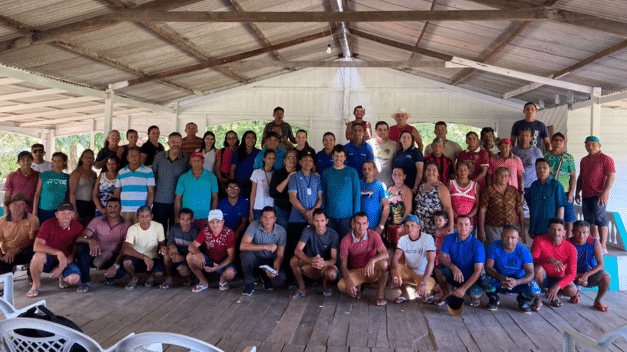
Santarém and Recife, places with a rich food culture and many opportunities to strengthen sustainable urban food systems, were the cities visited by the Cidades e Alimentação (Cities and Food) project, a partnership between Embrapa Alimentos e Territórios and the European Union, between March 13 and 24. The cities selected for the project are part of LUPPA – the Urban Food Policy Lab.
In these locations, the Embrapa team collected data on local initiatives and interacted with city government teams working on programs aimed at strengthening food and nutrition security in both regions. In Santarém (PA), two technical meetings were held with teams from the departments of education, social assistance and agriculture, the municipal school food council and the food and nutrition security division, along with field visits. The team from the local unit of Embrapa Amazônia Oriental (Belém – PA) took part in the program.
“Santarém is an immense municipality in terms of area and has 200,000 mapped farmers. There are five cooperatives supplying the Programa Nacional de Alimentação Escolar (PNAE – National School Feeding Program) in Santarém, which has 12 formal cooperatives in total. The city government provides technical support for cooperatives to access the PNAE and the Programa de Aquisição de Alimentos (PAA – Food Acquisition Program), and this interaction boosts the local economy, has a positive impact on quality of life in rural areas and fosters short production and consumption circuits,” says Gustavo Porpino, the project leader.
One figure that caught Porpino’s attention is that in Santarém, 33% of public food purchases for the PNAE come from local family farming, a percentage above the 30% required by the Fundo Nacional de Desenvolvimento da Educação (FNDE – National Education Development Fund). According to the city government, the Federal Government’s transfer covers 30% of Santarém’s school meal costs.
Visit to growers in Santarém – The project team also met with rural growers from Piracãoera de Baixo, a community of
floodplain (várzea) farming located an hour by speedboat from Santarém. The farmers are organized in the Cooperativa de Agricultores de Várzea de Santarém (Coopruvas) and supply food to the PNAE.
“Between September and November 2022, Coopruvas sold R$394,000 through the PNAE. Of this total, R$315,000 was passed on to cooperative members. The main product is watermelon, with 92,335 kg sold for R$305,000,” reports Porpino.
“The connection between school meals in Santarém and local growers’ cooperatives is a success story that has already sparked FAO’s interest in replicating the practice in other regions facing similar challenges in getting family farming produce to market,” he adds.
The project also learned about the School Gardens program, present in 24 schools in the municipality in Pará. At the César Simões Ramalheiro school, located in the “área verde” neighborhood, a low-income area, students help tend the garden and are already taking what they learn at school back home. Graziela Nascimento, 14, a 9th-grade student, says she planted a garden at home based on what she learned at school. Tainara Correia, 15, also a 9th-grade student, started eating vegetables after the experience of watching leafy greens grow in the school garden.
Gravimetric analysis in Recife – In Recife, the project analyzed organic waste at four street markets to quantify and categorize food waste, a practice known as gravimetric analysis. The quantification was supported by Abrelpe, the City of Recife and the collaboration of students from the Universidade Federal Rural de Pernambuco (UFRPE).
The capital of Pernambuco has an urban agriculture department responsible for coordinating actions to promote food production in the metropolitan region, and in 2021 it launched its 1st Urban Agroecology Plan. “Recife’s urban agriculture program includes an agroforestry system and composting in the city hall courtyard, a seedling nursery, school gardens and the mapping of farmers and agroecological markets. The city has 40 agroecological markets and another 25 smaller points of sale for vegetables and fruit grown locally without pesticides,” reports Porpino.
The trip to Recife also included visits to school gardens, the seedling nursery, the city government’s seedling production site, a garden being set up at the alcoholism treatment center and the food bank run by Serviço Social do Comércio (Sesc) at the Ceasa (wholesale supply center) of Pernambuco. The Mesa Brasil program’s food bank, founded 20 years ago, is one of the largest in Brazil. In 2022, it distributed 2.1 million kg of food.
“Analyzing the food system of these cities based on their trajectories, to understand the causes and reasons for their achievements and also how each city sees its challenges, is a great lesson about urban food systems, especially from the perspective of cities with different biomes, sizes and histories, which nonetheless generate information that is often common to many Brazilian cities,” notes Juliana Tângari, director of Comida do Amanhã and general coordinator of LUPPA.
The project “Cidades e alimentação: governança e boas práticas para alavancar sistemas alimentares urbanos circulares” (Cities and Food: Governance and Good Practices to Leverage Circular Urban Food Systems) is led by Embrapa Alimentos e Territórios, an Embrapa unit headquartered in Maceió (AL), in partnership with the European Union, through the EU–Brazil Sector Dialogues, and is supported by Instituto Comida do Amanhã, ICLEI América do Sul and WWF Brasil.
Photo: Elias Rodrigues