
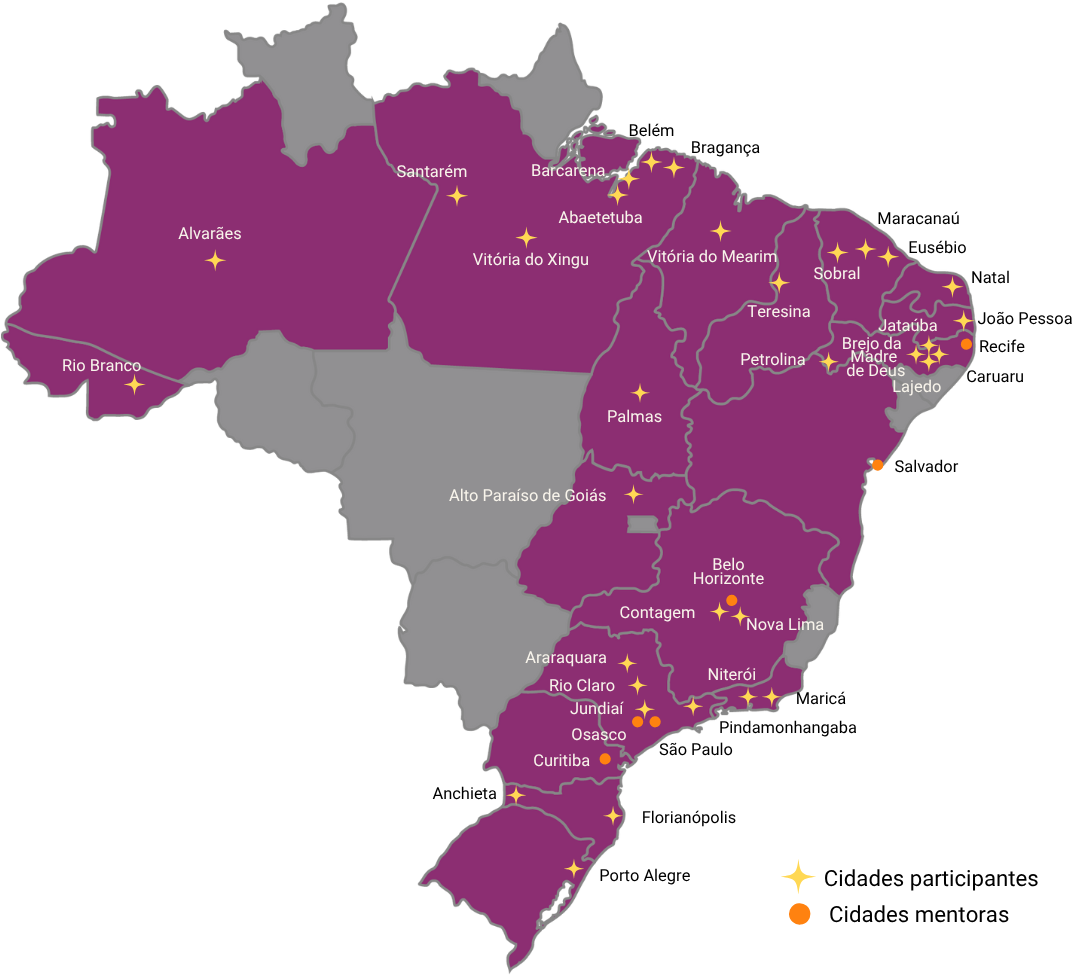
This Thursday, September 8, LUPPA WEB – Lessons from the 1st LAB and launch of the 2nd edition took place. At the event, LUPPA’s general coordinator, Juliana Tângari, shared the results of the first LAB and presented the cities that will take part in the second edition of the Laboratório Urbano de Políticas Públicas Alimentares (Urban Laboratory of Public Food Policies).
See the selected cities below:
- Abaetetuba (PA)
- Alto Paraíso de Goiás (GO)
- Barcarena (PA)
- Eusébio (CE)
- Jundiaí (SP)
- Maricá (RJ)
- Nova Lima (MG)
- Palmas (TO)
- Pindamonhangaba (SP)
- Vitória do Mearim (MA)
The opening of the event featured the representative of FAO Brazil – Food and Agriculture Organization of the United Nations, Sérgio Dorfler, who presented the context of LUPPA as an important instrument for transforming food systems and stressed that FAO sees local governments as key allies in this endeavor, since they are on the front line of managing agri-food systems. “Initiatives such as LUPPA, which seek to highlight the work carried out by municipalities on food policies, are an example of spaces for cooperation and integration that we count on to support us in disseminating and implementing important frameworks of our Organization, such as the Urban Food Agenda and the 2030 Agenda for Sustainable Development,” Dorfler emphasized. The experience reports from the 1st edition of LUPPA were presented by Maíra Colares, Secretary of Social Assistance, Food Security and Citizenship of Belo Horizonte, a LUPPA mentor city; Ivan José Canci, Mayor of the City of Anchieta in Santa Catarina; and Emídio Silva, Coordinator of Programs and Projects at the Office of the Deputy Mayor of Sobral, in Ceará. They revealed that all three cities were positively impacted in their food agenda, especially in ensuring mechanisms for monitoring Food and Nutrition Security (FNS). According to Maíra Colares, the project made major contributions to Belo Horizonte – even though it is a municipality with a tradition of working on FNS policies. Through the exchange of experiences promoted by LUPPA, the municipality was able to propose new solutions to existing challenges. Ivan Canci, in turn, highlighted that the project provided the opportunity to restructure the various spheres of Food and Nutrition Security policies. According to the Mayor, there is a before and after LUPPA for Anchieta, since the experience of taking part in the laboratory helped the municipality hold its 1st Food and Nutrition Security Conference and restructure its Food Security Council, among other actions on the topic. Emídio Silva, representing the city of Sobral, highlighted that FNS policies developed intersectorally – both inside and outside the public administration. Through LUPPA, several organizations in the city began to collaborate and contribute to carrying out structuring projects for local food systems. LUPPA is a project conceived by Instituto Comida do Amanhã and carried out jointly with ICLEI South America, with full support from Instituto Clima e Sociedade and Instituto Ibirapitanga and institutional support from Humane Society International, Mercy for Animals – Programa Alimentação Consciente Brasil and ACT Promoção da Saúde.