
First workshop of the work plan developed by Rio Branco, stemming from the award granted by LUPPA, was held on June 7
The joint work between Rio Branco and LUPPA, as part of the award offered to a city from the Amazon region participating in our first edition, keeps bearing fruit! On Tuesday, [...]
08/06/2022
|
17
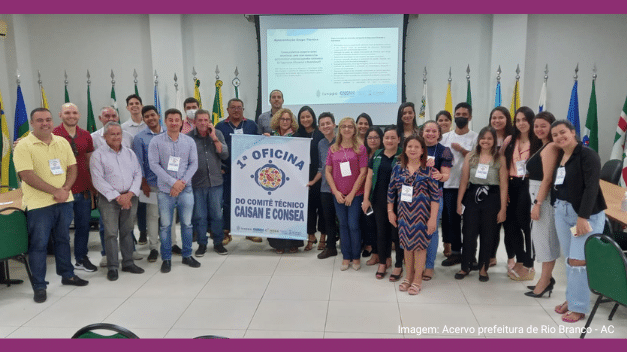
The joint work between Rio Branco and LUPPA, as part of the award offered to a city from the Amazon region participating in our first edition, keeps bearing fruit!
On Tuesday, June 7, the first workshop of the work plan developed to support the creation of the Municipal Food and Nutrition Security Plan took place.
The workshop was the starting point for the reactivation of the Municipal CAISAN – Interdepartmental Chamber for Food and Nutrition Security and for the establishment of the Technical Chamber that will lead the work of building the municipality’s FNS (food and nutrition security) plan.
The meeting was attended by representatives of the seven municipal departments that make up the municipality’s CAISAN: Social Assistance and Human Rights, Agriculture, Environment, Education, Health, Planning and Development, Technology and Innovation, and the Chief of Staff’s Office (Casa Civil).
The Technical Chamber analyzed the Municipal Food and Nutrition Security Agenda – actions involving food’s journey from farm to plate, to meet the legitimate demands of the population and guarantee the human right to food – and reflected on how the departments can cooperate to create new and/or strengthen existing Food and Nutrition Security projects/agendas.
The Mayor of Rio Branco, Tião Bocalom, took part in the opening of the event, spoke about the importance of the meeting and emphasized the need to think about local production to supply the municipality. “We need to think about producing our products here, so that they are of higher quality and consequently become cheaper. It is essential that we discuss food security at length, so that the population has better quality and healthier food,” the mayor stressed.
Francine Xavier, director of Instituto Comida do Amanhã, attended the meeting representing LUPPA and highlighted in her remarks that food needs to be thought about systemically, from production to consumption.
“There is a myriad of situations and policies that can be created to truly guarantee food for the population and to build a fairer and more sustainable food system. When the municipality begins to understand food as a system, all departments can act together,” Francine explains.
This workshop kicks off the work of building the FNS Plan and reinforces the role of intersectoral work in building fairer, healthier and more sustainable food systems.
The event was featured on Jornal do Acre 2ª edição. Click here to watch the report.