
LUPPA municipalities stand out in the election of the National Board of Municipal SAN Officials
On August 11, the Founding and Election Assembly of the National Board of Municipal Food and Nutrition Security Officials (Colegiado Nacional de Gestores Municipais de Segurança Alimentar e Nutricional) took place. [...]
28/08/2026
|
7
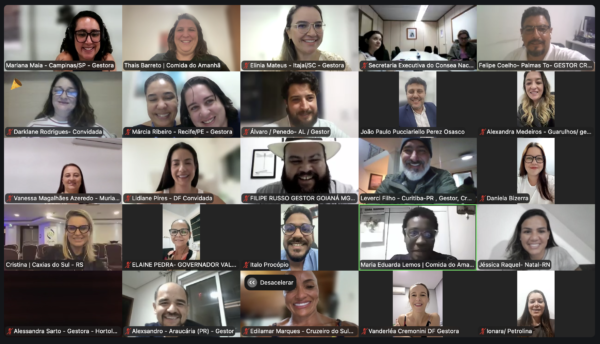
On August 11, the Founding and Election Assembly of the National Board of Municipal Food and Nutrition Security Officials (Colegiado Nacional de Gestores Municipais de Segurança Alimentar e Nutricional) took place. The event had more than 70 participants, who approved the bylaws and elected the first national board for the 2026–2028 term. Of the 13 members of the elected board, 9 are from LUPPA cities.
For Thais Barreto, director of Instituto Comida do Amanhã, this milestone reflects the maturing of ongoing work. “LUPPA is heading into its sixth edition and, over these years, we have worked to strengthen the quality of public food policies through a collective effort with more than 70 cities from every region of Brazil,” she explains. She highlights that, more than a group of cities, the lab has formed a true community of people and officials engaged in promoting the SAN (food and nutrition security) agenda.
It was in this environment of cooperation that the idea took shape. According to Thais, the proposal to institutionalize the Board to strengthen local actors arose spontaneously within the LUPPA community. “For us, it is essential to bring municipal government to the center of the discussion on the right to food and to think about concrete conditions for implementing a policy that is, by nature, intersectoral. We received this proposal with great pride, and serving as the secretariat for this initiative was a natural path for Comida,” the director adds.
The coordination took shape in a very practical way during LUPPA LAB #5, hosted in Caxias do Sul (RS) in May 2026. For Cristina Fabian, director of Food and Nutrition Security of the municipality in Rio Grande do Sul and elected regional vice-director for the South, the in-person meeting played a decisive role. “It was during this event that coordination among the municipalities was strengthened and the creation of the National Board was fostered,” she recalls. She emphasizes that regional representation on the new board is vital in such a diverse country, ensuring that “local particularities are considered in shaping national agendas, while at the same time strengthening the development of joint solutions”.
Collective effort and a focus on the territory
This plurality and focus on the territory are also pillars for Marcia Ribeiro, Executive Secretary for Food and Nutrition Security of Recife (PE) and newly elected president of the Board. For Marcia, LUPPA was essential in placing cities at the forefront of the discussion. “After all, it is in the municipality that policies happen, where challenges arrive first and where we need to find concrete answers for the population,” she highlights.
Looking ahead to the term now beginning, the new leadership seeks to structure SAN bodies and ensure that cities are effectively heard. The president points out that the goals include advancing the National Food and Nutrition Security System (SISAN), improving public food facilities, promoting family and urban farming, and encouraging public procurement. Marcia stresses that all of this depends on building permanent co-financing mechanisms and greater technical cooperation with state and federal governments.
The consolidation of the Board embodies a powerful synergy: LUPPA strengthens capacities and brings cities closer together, while the new body ensures the necessary political representation. As Thais Barreto anticipates, “the Board will be very important for connecting officials and building common agendas, strengthening the national SISAN and giving visibility to the role of municipalities in decision-making spaces at all levels of government”. An expectation shared by Marcia, who envisions, by the end of this term, “a more connected municipal network, strengthened officials and an agenda that truly reflects the diversity of Brazilian territories in the fight against hunger”.