
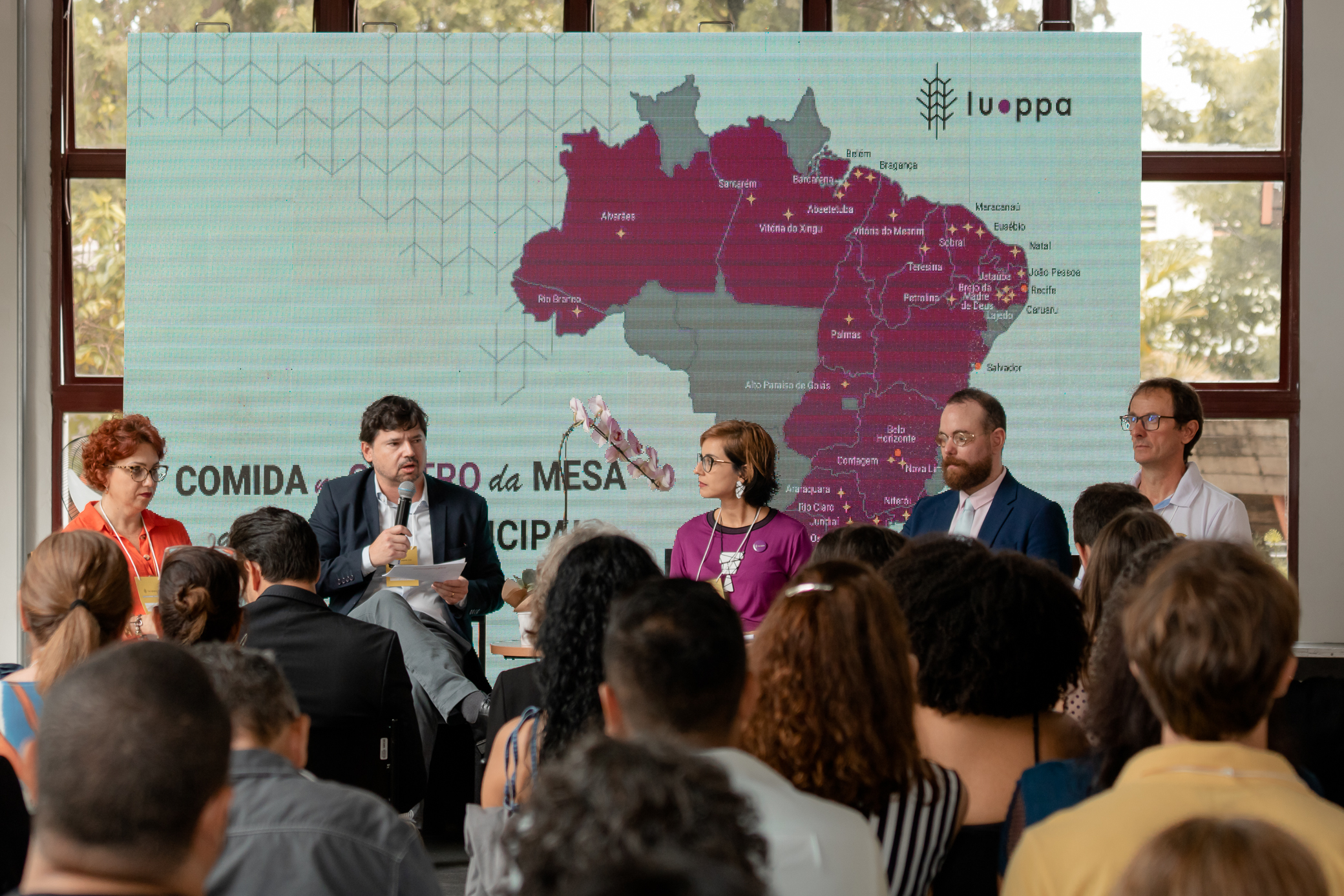
LUPPA is the Urban Food Policy Lab, where representatives of municipalities from across Brazil come together to work on building an integrated agenda of FNS – Food and Nutrition Security – and climate in their cities. The second edition of LUPPA LAB was held in person in the city of São Paulo from February 1 to 3, 2023. The article How the 2nd LUPPA LAB Went tells more about the participating cities, guests and technical visits of this event.
This edition had a special flavor thanks to the significant representation of the social oversight councils of the participating cities. In 66% of the municipalities, members of civil society took part in harmony with city government representatives, fulfilling one of LUPPA’s main objectives, which is to leverage the building of public policies with social participation. It is also important to highlight that more than 60% of those present were women, giving female voices the opportunity to be part of the transformation of food systems.
Another highlight of this edition was the territorial diversity of the cities present. There were 26 cities of different sizes and realities from the North, Northeast, Center-West, South and Southeast regions of the country. The Amazonian cities, with their context quite distinct from the rest of Brazil, had the opportunity to dialogue and exchange experiences and challenges with the other municipalities. In addition, 12 cities that took part in the first edition maintained their commitment to the LUPPA community and returned to participate in the second edition of the LAB, joined by the five mentor cities, Curitiba, Recife, Salvador, Osasco and São Paulo. The participation of these cities shows their engagement in the activities proposed by the LAB, and the importance of reflecting and acting on the dynamic nature of food systems.
We know that Brazilian state capitals are generally benchmarks for actions and public policies in different spheres. The broad participation of Brazilian capitals in the LAB demonstrates the relevance of, and a trend toward, commitment to the FNS agenda throughout Brazil. The capitals engaged in the LUPPA community are Rio Branco, Belém, Palmas, Recife, Salvador, Curitiba, Porto Alegre, Belo Horizonte and, notably, São Paulo, mentor city and host of the in-person event. São Paulo’s commitment can be seen not only in its hosting of the event, but also in the fact that the FNS agenda is distributed across eight municipal departments, with the Municipal Department of Economic Development and Labor as its focal point, which includes the Agriculture Coordination Office and the Food and Nutrition Security Coordination Office. The city’s engagement with the FNS agenda could also be seen in the presence of four departments at the LAB’s opening panel: the Municipal Department of Subprefectures, the Municipal Department of International Relations, the Municipal Department of Economic Development and Labor, and the Department of Human Rights and Citizenship.
Thus, the engagement and commitment of the cities can be seen both throughout the editions of LUPPA and at this in-person event, which had strong participation from cities and partners from beginning to end. Participants arrived highly motivated and left even more committed to including healthy and sustainable food systems as a central agenda of municipal public policy.
For this engagement to be real and ongoing, the LAB featured a very well designed methodological journey led by the LUPPA team with the support of Reos Partners. On the first day, in addition to the opening of the event, those present took part in a round of introductions, a short talk on extended collaboration and a rich experience-sharing activity. The latter included special guests in each group, enabling deeper reflection on the topics discussed in the groups and also aiming to clarify doubts and air concerns. On the morning of the second day, three simultaneous technical visits around the city were organized, offered by the City of São Paulo, with the aim of getting to know benchmark practices and public facilities. In the afternoon, the main activity was systems mapping, in which participants identified some of the themes and areas with the greatest impact for transforming municipal food systems so that they become healthier, fairer and more sustainable. Finally, on the last day, participants collectively worked on building the cities’ so-called “anchor project”. The anchor project is a tool developed by LUPPA to help cities identify and act on a leverage point for transforming the city’s food system in order to build or develop Strategic or Action Plans and FNS Plans that are intersectoral, participatory and grounded in a systemic vision.
In other words, holding the in-person LAB confirmed the ability not only to maintain the participation and engagement of the participating cities and partners, but also to innovate in its methodological proposal as a social lab aimed at uncovering the systemic causes of the current shape of food systems, so that real transformation can be put into practice through municipal public policies. All the proposed activities were guided by LUPPA’s four principles: intersectorality, political commitment, social participation and mutual learning.
All these factors are intrinsic characteristics of LUPPA, which enrich the exchange and sharing of experiences among cities and form a community that is engaged and committed to transforming food systems. The opportunity of an in-person event allowed for a more impactful result for participants, strengthening bonds, building a support network and, finally, awakening the collective intelligence of the participating cities. It is precisely with this result that a cultural shift in public management regarding food systems, and an understanding of the true and broad role of food policies, becomes possible and real.
And so we close this in-person stage with a sense of accomplishment. The in-person LAB managed to convey the intended messages and plant a seed in the participants and cities present. In fact, this is much more than just hope: it is the awareness that the impact achieved is already real and that the cities leave this event with an understanding of the importance of jointly building the food systems agenda in municipalities, with social participation, engagement, intersectorality, and broader, more inclusive governance. In other words, holding the LAB brings more than hope; it brings a real possibility of transforming food systems.
LUPPA is a project of Instituto Comida do Amanhã, co-organized with ICLEI América do Sul, with full support from Instituto Ibirapitanga and ICS – Instituto Clima e Sociedade, special support from the Delegation of the European Union to Brazil, Embrapa and WWF Brasil, institutional support from ACT Promoção da Saúde, Alimentação Consciente Brasil, the Food and Agriculture Organization of the United Nations – FAO Brazil and Humane Society International, and methodological partnership with Reos Partners.
Our second edition is mentored by the cities of Curitiba, Osasco, Recife, Salvador and São Paulo and by the organizations: Cátedra Josué de Castro de Sistemas Alimentares Saudáveis e Sustentáveis at USP – Universidade de São Paulo, CECANE – Centro Colaborador em Alimentação e Nutrição Escolar at UFAM – Universidade Federal do Amazonas, GEPPAAS – Grupo de Estudos, Pesquisas e Práticas em Ambiente Alimentar e Saúde at Universidade Federal de Minas Gerais – UFMG, GEPAD – Grupo de Estudos em Agricultura, Alimentação e Desenvolvimento at Universidade Federal do Rio Grande do Sul – UFRGS, IDEC – Instituto Brasileiro de Defesa do Consumidor, Instituto Kairós Ética e Atuação Responsável and Instituto Regenera.