
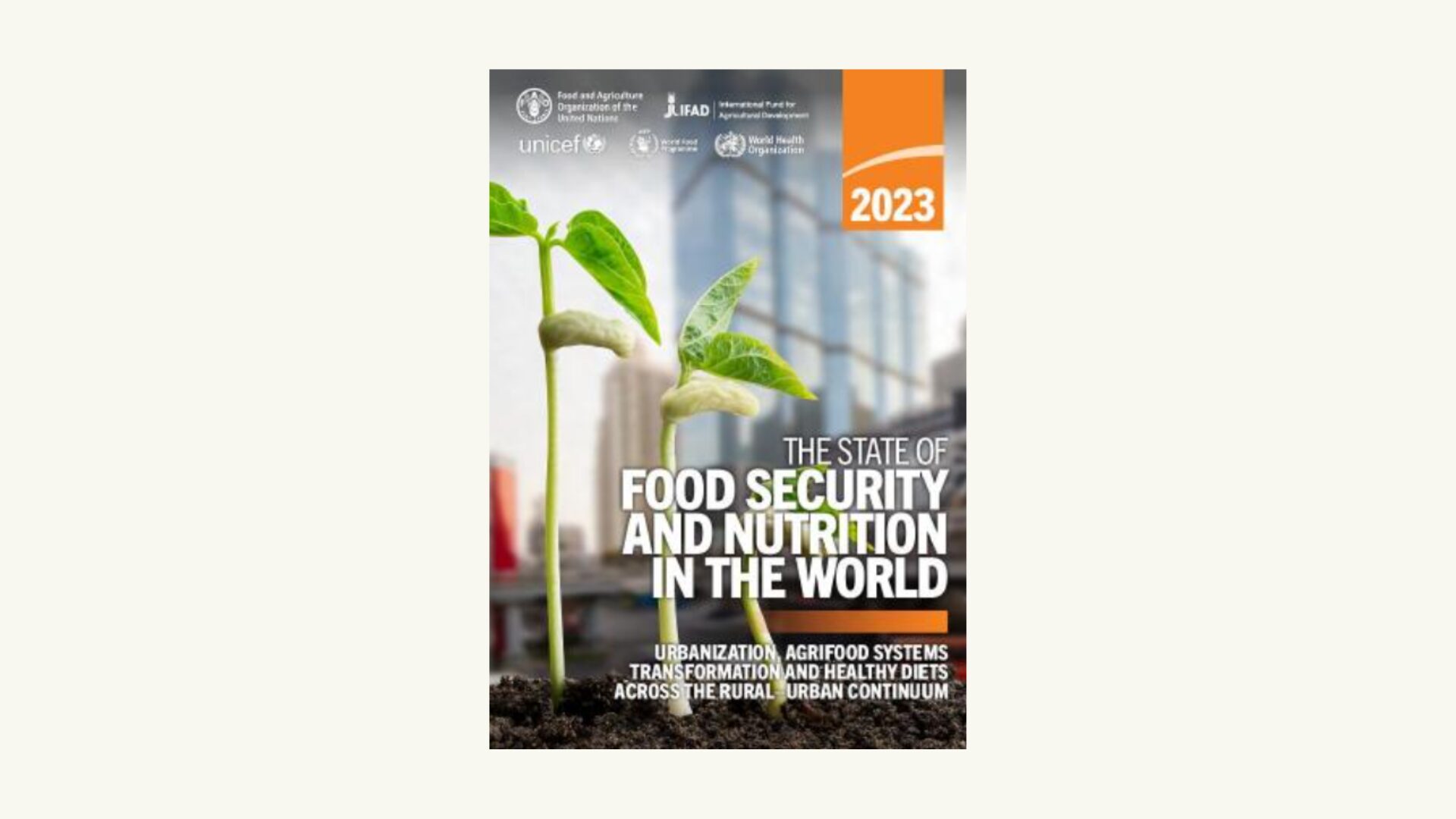
Every year FAO, the Food and Agriculture Organization of the United Nations (FAO/UN), together with the International Fund for Agricultural Development (IFAD), the United Nations Children’s Fund (UNICEF), the World Food Programme (WFP) and the World Health Organization (WHO), launches the report “The State of Food Security and Nutrition in the World” – SOFI. SOFI is the main global report mapping the state of food security in the world. It seeks to report on progress toward ending hunger, achieving food security and improving nutrition, and to provide an in-depth analysis of the main challenges to achieving SDG 2 in the context of the 2030 Agenda for Sustainable Development. In 2023, the report’s central theme is “Urbanization, agrifood systems transformation and healthy diets across the rural–urban continuum”.
Throughout the report, the most recent data on food security and nutrition worldwide are presented and discussed, along with the way urbanization is affecting agrifood systems, access to healthy diets, and food policies and solutions to leverage the transformation of agrifood systems toward healthy diets across the rural–urban continuum. This report marks a significant post-COVID-19 pandemic moment, when levels of hunger and food insecurity around the world rose dramatically. Even with a slow global economic recovery, other factors, such as the war in Ukraine and rising prices of food, agricultural inputs and energy, prevented a major reduction in these levels, keeping hunger stable globally, but still far above pre-COVID-19 levels and far from achieving Sustainable Development Goal – SDG 2, set for 2030.
Before presenting the data in more detail, it is important to clarify that hunger data in SOFI are measured using two indicators: PoU and FIES. PoU is the acronym for “Prevalence of Undernourishment”. It is an indirect and rather complex indicator of hunger, which considers a series of variables and national data, calculated over a 3-year period, and measures the estimated number of people who are unable to eat adequately. FIES, the “Food Insecurity Experience Scale”, is a measure based on the perception of household or individual food insecurity, allowing for breakdowns into severe and moderate food insecurity. Thus, throughout the text, whenever moderate or severe food insecurity is mentioned, the data were obtained from the FIES indicator. With these initial explanations, let’s get to the details.
Hunger in numbers
The data reveal that the proportion of the world population facing hunger in 2022 was around 9.2%, compared with 7.9% in 2019, measured using PoU. It is estimated that hunger affected between 691 million and 783 million people worldwide in 2022. In addition, in that same year, 29.6% of the global population – 2.4 billion people – were moderately or severely food insecure, according to FIES data. However, the relative lack of change in hunger at the global level from 2021 to 2022 hides differences at the regional level: there was progress in reducing hunger (measured by PoU) in most subregions of Asia and in Latin America, but hunger is still rising in Western Asia, the Caribbean and all subregions of Africa. We will discuss the specific case of Brazil in more detail later in the text.
Another important point is that, according to the Degree of Urbanization (DEGURBA) classification, a new international standard, the data reveal that, at the global level, food security improves as the degree of urbanization increases. Moderate and severe food insecurity affected 33.3% of adults living in rural areas in 2022, compared with 28.8% in peri-urban areas and 26.0% in urban areas.
Gender inequalities persist: food insecurity is more prevalent among adult women than men in every region of the world, although the gap narrowed considerably at the global level from 2021 to 2022. In 2022, 27.8% of adult women were moderately or severely food insecure, compared with 25.4% of men, and the proportion of women facing severe food insecurity was 10.6%, compared with 9.5% of men.
Progress toward global child nutrition targets
Globally, the prevalence of stunting among children under five years of age has been steadily declining, from an estimated 33.0% (204.2 million) in 2000 to 22.3% (148.1 million) in 2022. The prevalence of wasting in this age group also fell, from 8.7% in 2000 to 6.8% in 2022, which in absolute numbers represents a reduction from 54.1 million in 2000 to 45.0 million in 2022. These indicators point to a trend toward achieving the targets set for 2030: no more than 13.5% of children stunted and no more than 3% wasted. The report states, however, that despite progress on these indicators, greater allocation of resources to the most socially vulnerable countries is needed so that populations have access to the essential actions required to actually achieve these targets.
Child overweight, on the other hand, is heading in the opposite direction, with an almost uniform increase around the world, from 5.3% of children (33.0 million) in 2000 to 5.6% (37.0 million) in 2022. The 2030 target is for this percentage not to exceed 3%.
The most recent data on low birthweight revealed that 14.7% of newborns (19.8 million) were born with low birthweight (less than 2,500 g) in 2020, a non-significant decline from 16.6% (22.1 million) in 2000. For this indicator, the 2030 target is for this percentage not to exceed 10.5%.
Gains in exclusive breastfeeding among infants under six months of age are significant, rising from 37.0% (24.3 million) in 2012 to 47.7% (31.2 million) in 2021. Here is another target that, although still far from being met, is moving positively toward being achieved by 2030, when the goal is to reach 70%.
It is worth noting that differences between rural and urban populations were also identified in child nutrition. At the global level, the prevalence of stunting and wasting was higher in rural areas than in urban areas, while overweight was more common in urban areas.
Urbanization and its consequences
The report finds that to understand the changes that increasing urbanization causes in agrifood systems, it is important to reflect and act on the growing connectivity between urban, peri-urban and rural areas. Urbanization creates challenges for food systems, such as the increased availability of affordable ultra-processed foods, leading to rising rates of overweight and obesity; reduced availability of vegetables and fruits; the exclusion of small-scale farmers from formal value chains; and urban sprawl and the consequent reduction of farmland. However, it also creates opportunities, such as the expansion of income-generating activities along value chains, a greater variety of nutritious foods, and greater access for farmers to agricultural inputs and services as urban areas move closer to rural areas.
Access to healthy diets
The revised analysis presented in this year’s report shows that almost 3.2 billion people worldwide could not afford a healthy diet in 2020, with a slight improvement in 2021 (a reduction of 52 million people). In many countries, the rising cost of a healthy diet was coupled with falling incomes due to the COVID-19 pandemic and its consequences. Most people unable to afford a healthy diet in 2021 lived in South Asia and in Eastern and Western Africa.
In a study of 11 African countries, presented throughout the document, it is estimated that, on average, the percentage of the population unable to afford a healthy diet in peri-urban and rural areas is approximately 1.5 times higher than in urban centers.
Looking at Brazil
Estimates for Brazil indicate that a total of 32.8% of the population lived with severe or moderate food insecurity on average over the 2020–2022 three-year period, which represents 70 million people in absolute numbers. Compared with the pre-pandemic three-year period, 2017–2019, this is an increase of almost 60%. Regarding severe food insecurity, considered a state of hunger, the data show 21.1 million people in this condition. For both figures, measurement was carried out using the FIES indicator.
It is worth clarifying that the differences between the data published by the SOFI report and by the II VIGISAN are largely due to the calculation models used by each. While SOFI indicates a percentage of 9.9%, or 21.1 million people facing hunger in Brazil, II VIGISAN reported 15.5%, or 33.1 million people in the same period. The SOFI estimate uses the PoU and FIES indicators, whereas II VIGISAN takes an annual snapshot in conducting its study, applying the Brazilian Food Insecurity Scale (EBIA). Although PoU and FIES are completely different indicators, FIES is more similar to EBIA, as both are food insecurity scales based on the perception of moderate or severe food insecurity. There is also a difference in the cut-off points for moderate food insecurity between FIES and EBIA.
For this reason, data from both SOFI and II VIGISAN should be considered, since they cover different time frames with different methodologies, but provide perspectives on both the more immediate state of hunger and the more consolidated hunger picture. The fact is that the available data lead us to look at trends in food insecurity estimates which, in recent years, regardless of how the data were collected, point to a sharp increase in food insecurity in the country.
LUPPA highlighted as a Food Lab in SOFI
At the end of the report, policies and solutions are presented to scale up the transformation of agrifood systems toward healthy diets across the rural–urban continuum. The examples range widely across policies and investments; technology and innovation; and integrated planning and governance mechanisms.
Among the solutions that bring about powerful transformations, “food labs” models were cited, and SOFI pointed to Brazil, through LUPPA, as a leading example to be followed to achieve SDG 2. LUPPA is a project of Instituto Comida do Amanhã, co-implemented with ICLEI América do Sul, and is a collaborative platform to facilitate the development of integrated, participatory municipal food policies with a systemic approach. LUPPA seeks to encourage Brazilian municipalities to work on building an integrated agenda for food and nutrition security (SAN) and climate.
The question every year: will we meet the SDG 2 targets by 2030?
As the UN has warned in recent years, the world is far from meeting the targets of the 2030 Agenda, and the SDG indicators, except for some of those related to child nutrition, follow the opposite trend, moving further and further away from the Zero Hunger Goal. Expectations regarding hunger and food insecurity around the globe are for a slow improvement, and various regional and local factors make this improvement more complex and slower. Nevertheless, one thing is certain: there are many successful experiences in transforming agrifood systems and improving access to healthy diets across the rural–urban continuum. It is now up to governments, the private sector and civil society to ensure that these solutions are actually consolidated in their action plans.
In the coming days, the international community will once again gather in Rome for the follow-up meeting of the UN Food Systems Summit, held in 2021, which now, two years later, invites countries to present their progress on the goals and commitments set at the time. The meeting, called the UN Food Systems Summit +2 Stocktaking Moment, takes place from July 24 to 26 at FAO headquarters, in collaboration with the entire UN system and its agencies that are part of the UN Food Systems Coordination Hub. National delegations will meet at the beginning and end of the meeting, and several panels and side events will take place around the themes of the main coalitions formed at the 2021 Summit.
This is yet another opportunity that national governments and the international community cannot miss to realign actions in their countries with the goals of the 2030 Agenda, especially with regard to Food Systems, the fight against hunger and ensuring that agricultural practices meet the requirements of climate change adaptation and mitigation, protection of the rights of Indigenous peoples and compliance with planetary boundaries.