
The importance of school feeding programs before, during and after the Covid-19 pandemic
Photo: Andre Borges | Agência Brasília Over recent decades, school feeding has grown stronger as an important policy for social protection, for promoting education, health, gender equity, food and nutrition security, [...]
29/04/2021
|
10
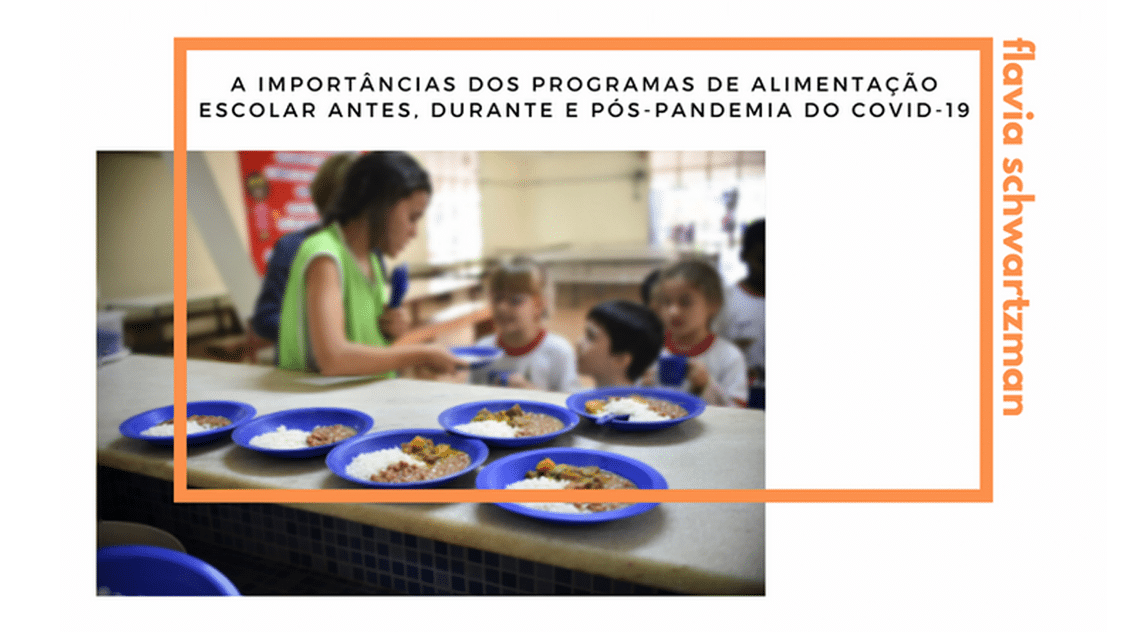
Photo: Andre Borges | Agência Brasília
Over recent decades, school feeding has grown stronger as an important policy for social protection, for promoting education, health, gender equity, food and nutrition security, and local development in many countries around the world.
The relevance of school feeding programs (SFPs) became even more evident during the COVID-19 pandemic, as access to schools was compromised and millions of children and young people stopped receiving the meals to which they were entitled. At the peak of the first wave of the disease, in 2020, schools were closed in 199 countries and 370 million students stopped receiving school meals (WFP, 2020). This situation imposed yet another major challenge on the most vulnerable families during this period, since before the pandemic they did not need to worry about part of the family’s food, which was provided by the school.
In addition, contracts for purchasing food from family farmers for school feeding were suspended in several municipalities across the country, leaving thousands of families who already had a guaranteed market for their produce in the lurch and compromising these families’ food and nutrition security.
Given the importance of the topic, the purpose of this text is to present a brief summary of a recently released document, the State of School Feeding Worldwide 2020 report, published by the United Nations World Food Programme (WFP), winner of the 2020 Nobel Peace Prize. The document analyzes various aspects of school feeding at the global level and examines what has changed since 2013, when the report was first published, highlighting progress and challenges, and also presenting the way forward, taking into account, above all, the relevance of these programs during and after the COVID-19 pandemic.
Below are the main findings, taking into account progress and challenges between 2013 and 2020:
- Expansion of SFPs. In 2013, 355 million students worldwide received school meals. At the beginning of 2020, before the pandemic, SFPs were delivering more school meals than at any other time, becoming the largest social safety net in the world. Based on data from 163 countries, it was found that in 161 of them (99%), approximately 388 million students – one in every two students worldwide – benefit from some type of school feeding. The expansion was most pronounced in low-income and lower-middle-income countries, as a result of increased financial and political efforts, where the number of children receiving school meals increased by 36% and 86%, respectively. The largest SFPs are in India (90 million children), Brazil and China (both 40 million), the United States (30 million) and Egypt (11 million). Almost half of the children receiving school meals worldwide live in one of the five BRICS countries (188 million).
- Strengthened institutionalization of SFPs. Since 2013, the institutionalization of the programs has been strengthened. Globally, 80% of countries have a school feeding policy, representing 4 out of every 5 countries, compared with 42% in 2013. The increase in institutionalization was most pronounced in low-income and lower-middle-income countries, as part of government policies for national development, where the proportion of countries with a school feeding policy rose from 20% to 75%.
- Greater national investment. Governments have increased investment in SFPs, and currently between $41 billion and $43 billion are spent annually on these programs, more than 90% of which comes from national funds. In low-income countries, the share of national funding in overall school feeding spending increased from 17% to 28%, leading to less dependence on international donors. By way of comparison, in high- and middle-income countries, SFPs are almost universally supported by national funds, and total national investment exceeds 95% of total costs.
- Stable cost of school feeding. The annual cost of an SFP has changed little since 2013, and the cost of feeding a child remains broadly similar across all countries and income groups. Data from 2020 indicate a cost of $55 (in 2013, it was $50) in low-income countries, $41 ($46 in 2013) in lower-middle-income countries, and an unchanged cost of US$57 for 2020 and 2013.
- School feeding recognized as part of an investment package. Of the 161 countries, 93% of governments implement school feeding as part of an integrated package of complementary school health and nutrition interventions, such as vaccination, oral health programs, deworming, food and nutrition education, handwashing with soap, food and nutrition surveillance, eye exams, menstrual hygiene, drinking water and water purification.
- Coverage gap among the most vulnerable. In 2013, school feeding coverage was lowest where it was most needed. In 2020, although the gap had narrowed, 73 million of the most vulnerable children were still not receiving meals at school. On average, 20% of school-age children in low-income countries receive school meals, compared with 45% in lower-middle-income countries and 58% in upper-middle-income countries. In the five BRICS countries, average coverage is 61%.
Other important points highlighted in the document are:
- Benefits of SFPs. Studies demonstrate the benefits of these programs, such as improvements in children’s education and in their physical and psychosocial health, with most of the benefits going to the most disadvantaged children. Recent studies have revealed effects on learning outcomes, mathematics and literacy, with greater effects among girls and boys below the national poverty line.
- Contribution to gender equity. The provision of meals attracts girls to school, and their staying in school helps reduce child marriage and teenage pregnancy in several countries, in addition to improving their diets.
- Contribution to resilience in the face of conflicts and emergencies. School feeding also becomes essential for students living in conflict situations, as it ends up contributing to peace and social cohesion in these regions by guaranteeing food for part of the family.
- Job creation. SFPs have led to the creation of 3.1 million direct jobs in 48 countries, equivalent to 1,668 new jobs for every 100,000 children and young people receiving school meals.
- Return on investment. For every dollar invested in an efficient SFP, there is a return of up to 9 dollars, in addition to the effects on other sectors, such as education, health, nutrition, social protection and local agriculture.
- Contribution to reducing the impacts of climate change. When SFPs buy food from local producers, preferably organic, they help shorten food chains, minimize food waste, and contribute to building ecologically sound food systems.
Important reflections for 2021 and 2022
The report draws attention to some fundamental reflections that must be made in light of the challenges faced during the COVID-19 pandemic. First, it stresses the importance of investing in human capital, so that people can reach their full potential and contribute to national growth and economic development; and it points to a paradigm shift regarding the need to invest not only in the first 1,000 days of individuals’ lives but up to the first 8,000 days (approximately up to age 21). In this sense, school health and nutrition programs, including SFPs, are a highly efficient and smart way for governments to invest in social protection and in the growth, development and education of children and young people.
In addition, it points out that it is necessary to redefine what education is and to recognize that investing in students is investing in the future, at both the individual and societal levels. School closures made it clear that education goes far beyond books and classrooms and that it is probably one of the most important pillars of communities and societies. Thus, it suggests that the concept of education should be broadened to encompass children’s health and well-being, as well as rebuilding quality, equitable health and nutrition services in all schools for all students.
School health and nutrition programs, and especially school feeding, play a fundamental role, acting as a strong incentive for parents to send their children to school and for children to stay in school.
The document raises some questions and suggests proposals for countries, as a starting point in the search for concrete actions to strengthen SFPs and address the challenges identified.
- How can global efforts be accelerated to safely reopen schools closed in response to the COVID-19 pandemic and at least return to where things stood at the beginning of 2020?
- How can innovative financing approaches bring hope to the 73 million children most in need? Technical assistance is recommended to support governments in further improving cost efficiency and maximizing the impact of their SFPs.
- Given that available data on school feeding focus on public sector programs in low- and lower-middle-income countries, what can be learned from programs run by the BRICS countries, high-income countries and the private sector? Creating a robust global database of SFPs would help to better understand the variety of programs and broaden the scope of learning opportunities.
- Considering that SFPs that buy local products have proven effective in middle-income countries, how can low-income countries scale up efforts toward this same approach as part of their national programs? Low-income countries should be supported so that they can expand home-grown school feeding activities as key elements of their national programs.
- Given that SFPs are the world’s largest safety net and play a critical role in responding to conflicts and emergencies, how can the resilience of food systems be maintained and further increased through a new generation of more cost-effective and environmentally friendly SFPs?
By presenting all these data, the report highlights the enormous reach and potential of SFPs as strategies for food and nutrition security, food and nutrition education and local development, which countries should strengthen, all the more so considering the roughly 690 million people who were going hungry worldwide in 2019, before the pandemic (equivalent to 8.9% of the world population), in addition to the 144 million children under 5 with stunted growth, the 47 million who are underweight, the 38.3 million who are overweight, and the 340 million with micronutrient deficiencies (FAO et al., 2020a).
Combating food and nutrition insecurity and the various forms of malnutrition requires a comprehensive and coordinated approach across sectors for the design, implementation and monitoring of the various public policies involved in the different stages of the food system, with a view to promoting the changes needed for more inclusive, fair, healthy and sustainable systems.
And SFPs, because of their wide reach and their enormous demand for products, are definitely part of the broad range of these policies, contributing to access to healthy diets for a large part of the population, while also having the potential to contribute to the balance of local food systems through their mechanisms of direct public procurement from family farmers.
During 2020, many countries made extensive efforts to create alternatives to keep delivering food to students, even while schools were closed for educational activities. Delivery methods in Latin American and Caribbean countries, for example, were diverse and included the distribution of baskets of non-perishable and, whenever possible, perishable foods, at school or at families’ homes, or food cards (RAES, 2020).
At this time, returning to or maintaining classes in a safe environment, whether in a hybrid or 100% in-person format, must remain a priority in order to reverse the damage caused by school closures. And, more than ever, officials must prioritize the provision of adequate, healthy school meals with products from family farming, respecting health regulations and nutritional and quality recommendations.
To access WFP’s executive summary and full report, in English, Spanish and other languages, except Portuguese: https://www.wfp.org/publications/state-school-feeding-worldwide-2020
References
FAO, FIDA, OMS, PMA y UNICEF. 2020. El estado de la seguridad alimentaria y la nutrición en el mundo 2020. Transformación de los sistemas alimentarios para que promuevan dietas asequibles y saludables. Roma, FAO. Available at: doi.org RAES (Red de Alimentación Escolar Sostenible).2020. RAES is promoted by the Government of Brazil with support from FAO, through the Project for the Consolidation of School Feeding Programs in Latin America and the Caribbean.
About the author
Nutritionist with a degree in Nutrition from the Faculdade de Saúde Pública (FSP – School of Public Health) of the Universidade de São Paulo (USP), a Master of Science from the Universidade Federal de São Paulo (Unifesp) and a PhD in Science from FSP/USP. She has worked as a consultant for the Food and Agriculture Organization of the United Nations since 2011. She has experience in the fields of food and nutrition in public health, working mainly on the following topics: school food and nutrition, food and nutrition security, food and nutrition education, and the promotion of healthy eating.