
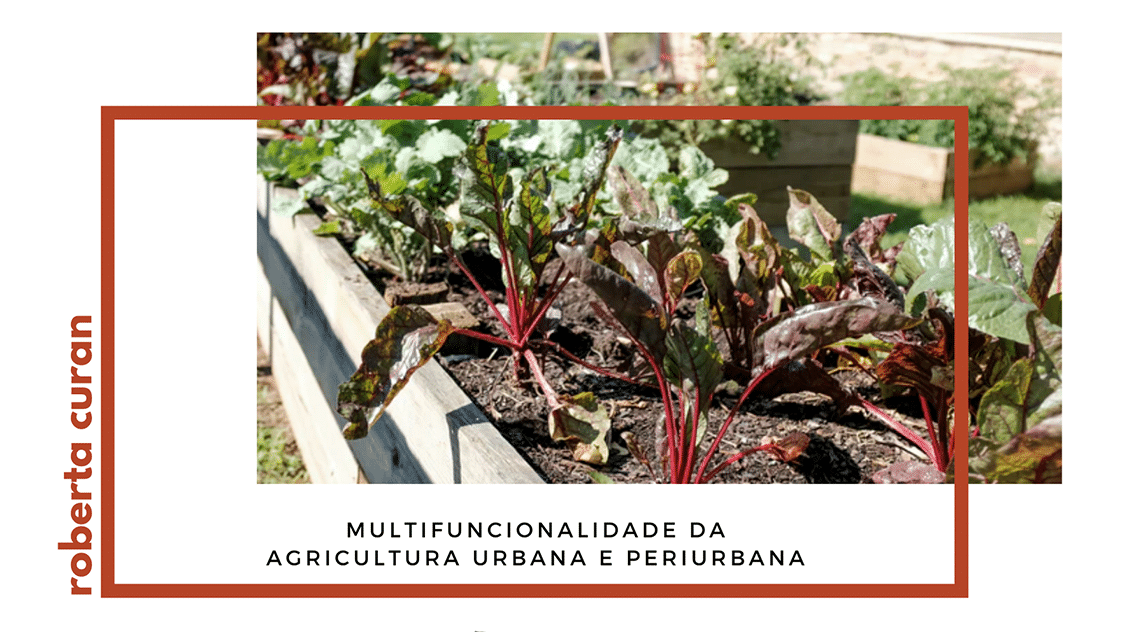
Talking about agriculture usually brings rural landscapes to mind, but did you know that it is possible to produce food in areas close to cities, or even inside them? Known as Urban and Peri-urban Agriculture, this practice is based on growing plants and raising animals within urban space or its surroundings, with well-defined characteristics such as the use of urban organic waste as fertilizer; proximity to the consumer market; and, of course, in this case the farmers are urban citizens.
In the context of a growing global urban population and the Covid-19 pandemic, Urban and Peri-urban Agriculture serves more than just the function of producing food. Gardens and areas set aside for production are often connected to environmental and social movements that claim the right to the city, the promotion of healthier and more sustainable cities, open-air spaces and contact with nature.
We know there are challenges tied to this practice, but the intention here is to show that this model can play an important role in the transition to food systems that are healthy and sustainable, inclusive and empowering, biodiverse and culturally integrated.
According to an article developed from my master’s dissertation and recently published in the journal Estudos Avançados of IEA-USP, in which I studied 14 scientific articles in depth, I show that the functions of Urban and Peri-urban Agriculture can be divided into three main dimensions: sociocultural, economic and environmental.
The sociocultural dimension encompasses roles of Urban and Peri-urban Agriculture such as food and nutrition security, health, social cohesion, the requalification of urban space, public safety, women’s empowerment, reconnection with nature, food and nutrition education, cultural development, appreciation of cultural heritage, leisure and recreation. I would highlight here that the improvement in food and nutrition security brought about by Urban and Peri-urban Agriculture occurs through production for the farmers’ own consumption and through increased income from selling products in local and regional markets, which makes it possible to buy other foods not produced in local gardens. In other words, Urban and Peri-urban Agriculture has the capacity to supply food to urban food systems, thus making fresh and nutritious food available, especially to populations located in areas where such food is commonly scarce. It is worth remembering that, according to the Guia Alimentar para a População Brasileira (Dietary Guidelines for the Brazilian Population, 2014), increasing the consumption of fruit and vegetables contributes directly to improving the health of those involved. Furthermore, Urban and Peri-urban Agriculture provides access to food in times of supply difficulties, such as runaway inflation, rising fuel prices, truck drivers’ strikes, and extreme environmental and health events such as the Covid-19 pandemic.
The economic dimension, in turn, includes poverty reduction, job and income generation, the strengthening of social contact between producers and consumers, the stimulation of new forms of distribution and marketing, less dependence on the global food market and the diversification of economic activities. In practice, Urban and Peri-urban Agriculture improves the lives of urban citizens by reducing farmers’ food expenses, since food is produced for family consumption; by generating income and increasing earnings from food sales; and by creating jobs along the entire production chain, offering work to the local population and to vulnerable groups as well. In addition, this type of agriculture has a very relevant characteristic: the proximity between production and the consumer market. This directly influences the way farmers and consumers relate to each other and how supply works, which has positive consequences such as greater value placed on contact between producers and consumers, farmers gaining a better understanding of the demands and expectations of consumer markets, and greater added value of products associated with differentiated markets, particularly if the food is agroecologically produced.
Finally, the environmental dimension is made up of functions that contribute to climate change mitigation and adaptation, with emphasis on the conservation of biodiversity, natural resources and agrobiodiversity, the cycling of organic waste, water and nutrients, efficient water resource management, greener cities and a smaller ecological footprint. One of the main highlights cited in the article mentioned above is the cycling of nutrients from urban waste and water. For example: water from sinks and washing machines, known as greywater, can be reused for irrigation once treated. Urban waste – especially organic waste – can be used as fertilizer after proper composting. Water resource management, in turn, offers other benefits, such as an increase in areas with permeable soils that favor water infiltration, with the consequent replenishment of groundwater and the control of floods and landslides. In this dimension, the proximity of production to consumer markets and the shortening of the supply chain are also important, as they reduce greenhouse gas emissions and transport costs, as well as reducing processing, storage and packaging use and costs.
The Covid-19 pandemic further highlights some of the functions that Urban and Peri-urban Agriculture can perform. In São Paulo, farmers from the Associação de Agricultores da Zona Leste (AAZL – East Zone Farmers’ Association) saw increased demand for their products, securing income for their families at a time of health and economic crisis and helping supply food to the city. Also during this period, the community garden in the Manguinhos community, in the city of Rio de Janeiro, gained visibility. This garden produces approximately two tons of food, which is donated to feed families, ensuring food security for this community. In addition, the farmers say that the citizens involved in the garden have learned to eat better, and that some of these people left drug trafficking, unemployment and depression behind to work in food production.
Thus, the practice of Urban and Peri-urban Agriculture has this multifunctional potential, and we understand that its various forms offer recognized benefits that can be strengthened through public policies, expanding not only the scale of these initiatives but also their use as a strategy for developing healthier and more sustainable food systems, especially in the transformation of urban and peri-urban environments.
References
CURAN, Roberta Moraes; MARQUES, Paulo Eduardo Moruzzi. Multifuncionalidade da agricultura urbana e periurbana: uma revisão sistemática. Estudos Avançados, v. 35, n. 101, p. 209–224, 2021. Available at: www.scielo.br CURAN, Roberta Moraes. Multifuncionalidade da agricultura urbana de base agroecológica: um estudo na Zona Leste do município de São Paulo/SP. 2021. Available at: teses.usp.br Guia alimentar para a população Brasileira. Available at: bvsms.saude.gov.br FERREIRA, Jaqueline. Agricultura urbana faz a diferença em tempos de pandemia. Nexo Jornal. Available at: nexojornal.com.br Conheça o projeto Horta Manguinhos do Rio de Janeiro. Engenharia 360 | Engenharia para Todos. Available at: engenharia360.com
About the author
Roberta has ten years of experience in research and technical work focused on sustainability, climate change, agriculture, food and the transition to sustainable food systems in the public and private sectors and academia. She holds a degree in Environmental Engineering and a master’s in Applied Ecology, and is a PhD candidate in the Applied Ecology Program (ESALQ/USP).